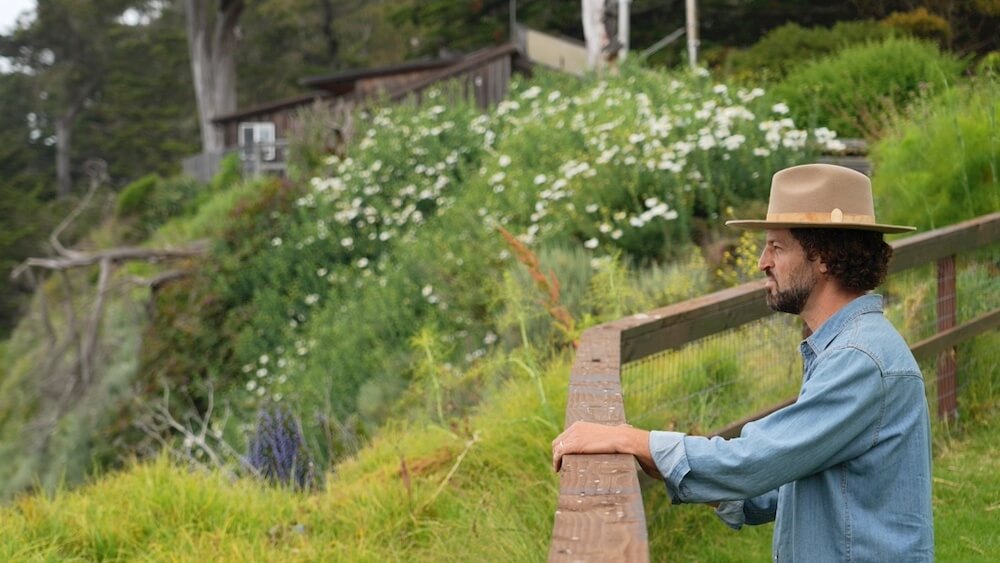
Voices of Esalen’s Sam Stern attends Soulstice Soulfire: Embodied Awakening Through Yoga, Dance, and Sound with Cristi Christensen and is reminded how the body understands even when the mind makes things complicated.
I’m sitting crosslegged on a blue yoga mat, my thighs thick and ungainly, my breath coming to me in little shallow bursts. I’m in the Huxley room at Esalen alongside about forty other curious seekers, feeling mildly shut down and skeptical, as is my custom much of the time, particularly around new people. I’m staring at a tarot card that I just picked: Joy. Inwardly, I groan. Joy’s not really my flavor.
At the front of the room, our teacher, Cristi Christensen — elfin, pretty, definitely joyful — greets us enthusiastically and begins introducing the themes of our week together. “Chakras,” she announces enticingly. “Otherwise known as portals to embodiment.”
She delivers her gospel so convincingly that I have to consider the message. Cristi brings real gravitas to the room, too, in light of the fact that she has been battling advanced-stage cancer for three years. Clearly, she’s a fighter, but not a brawler; more like someone whose long proximity to uncertainty has made her careful, and uncommonly awake. A powerful gratitude gathers around her, luminous and unmistakable.
She’s backed by DJ Marques Wyatt, a quiet, poised man who is playing music softly in the background the whole time that she’s teaching, expertly adjusting volume, vibe, and BPM to suit her meaning and message. Marques looks to be about my age, which is to say: 50.
50 years old.
The number hits me with a soft thud. I’m half a century gone. Indeed, the years have etched some rather deep grooves into the mountain that is me. My neck and back stiffen up on me without warning, testament to long hours spent in front of a computer screen, editing podcasts and videos. My mind, too, has stiffened in places: I’ve acquired certain well-worn inner paths, chief among them worry, self-criticism, and judgment. Occasionally, I get a glimpse at joy - usually through my seven-year-old daughter’s eyes - but for the most part, it’s not something I’m focused on.
Cristi invites us to stand.
“Let’s move.”
To my surprise, I don’t resist. The healthy skepticism I’ve brought into the wood-paneled realm of Huxley seems to loosen its deathgrip once some momentum enters my body.
We get up from our mats and, surveying one another shyly, start to move about the room. We begin with simple movement, then shaking: hands, legs, shoulders. Soon I’m hopping in place, yelling a little, watching forty grown people begin to come alive under the command of Marques’s low, pulsing, almost devotional house music.
I don’t know these people. I’m not really rooting for them yet. But we are all sweating, swaying and hopping and shaking, our breath getting louder. We’re letting our bodies become stranger, less managed. Something about their willingness lifts me. Their energy gives me permission.
“Deep inside our bodies,” Cristi orates, her headset mic hovering just beside her mouth, “in our tissues, in our fascia, patterns get formed.”
This lands for me. Of course, my body has patterns, etched in deep. So does my mind. So does my life.
So I shake. I hop. I fling my arms around to the bass-heavy pulse. I attempt, in my highly dignified way, to become less predictable.
By Tuesday morning, whatever had been shaken loose in me the night before settles back into a more familiar arrangement. I’m under-caffeinated and not especially eager to receive a lecture on chakras.
Like, why are they colored? my mind simpers. Seems kinda unrealistic.
But Cristi is a snappy lecturer, and she is well-prepared. Having literally written a book on the subject, she’s a convincing pitchwoman for her chosen path.
“Chakras are doorways to the divine,” she says, pointing to a diagram of a human body.
Grudgingly, and only because I recognize a good turn of phrase when I hear one, I write the words down in my mostly-blank leather-bound journal. I try not to be in touch with the divine before 1:00 P.M. if at all possible.
Soon I give in to the urge to sneak out of class and grab another half a cup of coffee. It’s a good move: the added caffeine definitely aids my note-taking. Guilt can block the flow of frequency, I scrawl. True; my frequency is constipated. Practice is a path to liberation. Brow furrowing, I keep the pen flying, trying to expand my mental map to include all the new territory and terminology: malas, chakras, and mantras. Oh my.
Then pendulums are introduced, which, ordinarily, would be a step too far — despite my chosen new-age-adjacent milieu, I’m an atheist from birth, allergic to astrology and miracles — but I decide to make an exception in this case, mostly, to be honest, because of Cristi. If she can show up so full of vitality and positivity in the face of a multi-year battle with life and death, then I suppose I can take careful consideration of her practices. With a sigh, I let the pendulum sway, asking it little questions, watching for the tiny grammar of its movements.
Our playful engagement with divination gives way to a bracing yoga session. After a decade of consistent practice post-college, I don’t end up on the mat very often these days, but, to my satisfaction, I discover that I still can eke out an hour of challenging practice. In fact, I realize, sweat pouring down my face, limbs trembling, breath coming in rushes, I might be a stronger yogi than I used to be. I’m more in my body. I’m calmer. All around me, my compatriots are engaged in their own private negotiations with gravity, age, pride, and hamstrings.
Even better yoga? The yogic afterglow. I’d nearly forgotten what it feels like to let prana have its way with you, course willy-nilly through your body like a lover. On our lunch break, I turn on a heel and scurry down to the hot spring baths. There, I immerse my body into scalding water, intermittently plunging into a punishingly cold tub. I repeat until I’m mumbling little ecstasies to myself that would embarrass any skeptic.
In the Lodge, still damp from the baths, I make myself some tea and wind up beside a woman from my class. She asks how I’m doing.
“Pretty well,” I admit — both true and totally inadequate.
We laugh, not because I said anything all that witty, but because the morning has left us both a little exposed. Before we can wander into confessional territory, I retreat to my book, Tobias Wolff’s This Boy’s Life, grateful for the company, equally grateful not to have to sustain it.
Come afternoon, we reconvene in Huxley, casting braver glances at one another. Various people attempt to give voice to their transformations thus far, and I am surprised to find that I do not immediately retreat behind my customary wall of judgment. It occurs to me that my body may be able to absorb wisdom my mind has spent years making more complicated. I grin, enjoying, if only for a moment, an unselfconscious version of happiness.
For the first time this week, this does not strike me as embarrassing.
By Wednesday morning, I’ve become just open minded enough to worry about myself.
Soon after class begins, we step out onto the wooden deck, encircling two classmates who have the fortune to be celebrating birthdays in the middle of this unfolding experiment - a gentleman about my age, maybe 5 or 8 years older, with grey beard stubble and lots of good dad energy, and a slim woman is in her early 30’s who’s come here from Hawaii with her mother. We send them special good vibes through our fingers and hearts. They begin tearing up almost immediately.
I’m touched. Happy for them, in fact.
A half-remembered word swims into my consciousness: Mudita. The joy that comes from experiencing someone else’s joy. For once, this doesn’t feel like a term from a dharma talk, or a concept I can admire from a safe intellectual distance. I can sense it moving through the circle, passing from face to face, hand to hand.
I nod my head, silently thrilled at my development. Clearly, my enlightenment is nearly complete.
Then Cristi begins discussing malas, or spiritual sufferings. “We’re going to be burning through some malas today,” she promises. “Through patience and ritual, we can cleanse the mirror.”
I’m available for that, I decide, and half a cup of coffee later, I’m jotting down notes with secretarial zeal. Anava Mala, the Spell of Not Enough, is all about inadequacy, unworthiness, the ache of believing that whatever you are, whatever you’ve done, still somehow fails to add up.
My ears do perk: this is pretty much the story of my life. My creative life has always moved in fits and starts: bursts of devotion, long silences, sudden returns, abandoned trails. When the silence stretches too long, I reach for the old weapon: a nagging inner voice that confuses punishment with motivation.
But I don’t actually want to be like this, I’m realizing. I want something gentler than the whip, though I am not yet entirely convinced I know how to work without it.
Fortunately, there are actions that can be taken. Mudras, ancient yogic hand gestures, can give the body a way to speak before the mind has a chance to interfere.
To combat lack of confidence, I attempt Vajrapradama Mudra, intertwining my fingers and placing them over my heart.
Then there are mantras, which I have historically regarded with suspicion: funny little sentences, engineered to make intelligent people say obvious things with unreasonable conviction. But, Cristi maintains, “mantras have power.” A mantra for the throat chakra can help “purify the poison that lives within us.”
I am enough, she suggests patiently.
I’m attracted to the powerful simplicity of the phrase. I am enough. I whisper it aloud a couple of times. My fingers, still intertwined, vibrate faintly.
I’d love to change my mind at the drop of a mudra. I’m not totally sure if I can absorb this message, though. Luckily, I don’t have to: Cristi offers us a smaller phrase, one that slips past my defenses more easily. If only for today.
If only for today, I murmur, I am enough.
It starts to sink in. I begin to play around with the words, flirting with different phrasings.
If only for today, I’m awesome.
If only for today, I’m brilliant and open. The beauty is in the conditional: because I don’t have to pretend to be a completely healed entity, I actually believe what I’m saying. It’s like I’ve got a day pass to enlightenment.
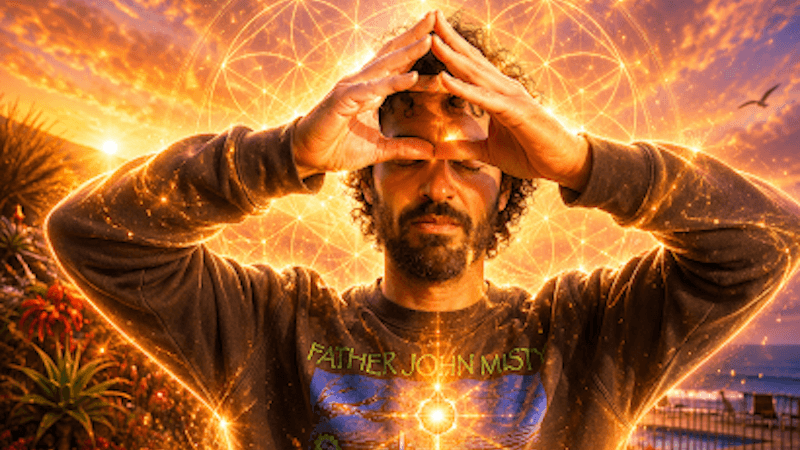
Later that afternoon, I’m feeling exhausted, but also strangely intimate with my own chakra system. I snap a few self-portraits out on the Esalen lawn, processing them through an AI image program to better illustrate the rivers of energy running through my fingertips. Even here, I am translating embodiment through proxy, asking a machine to show me what I am trying to feel.
That evening, Marques Wyatt takes over Huxley, and the room begins to thrum. I stand near the edge at first, performing my usual reconnaissance: who is dancing freely, who is pretending to dance freely, who might accidentally make eye contact with me. Then the bass thickens, and I find myself moving. Gyrating. Bobbing. Shaking. Becoming, against my better judgment, available.
Anava Mala briefly tries to show up and crash my personal party -— what up, 50 year old flabby pec dude? — but I silence her with a mantra: I’m here. I’m good enough to be here.
My body, which has been making a surprisingly persuasive case for itself as the wiser authority this week, takes the lead. Some minutes later, I’m actually not horribly embarrassed to be moving, to be seen, to be alive. Tonight, I’m just breath. I’m just spirit. I’m just prayers.
The others are going for it too; they’ve bought in. The childhood BFFs who’ve come to Esalen to get shake off the torpor of mom-hood; the elegant married couple in coordinated athleisure, moving with the solemn concentration of people who may have done this before; the handsome dude who looked at lunch like he might sell you a very expensive meditation app, now smiling as if the music has relieved him of some private burden.
I am rooting them on now.
And then, there it is. That card from Monday night.
Joy.
Apparently she has been following me around all week, waiting for the music to get loud enough for me to stop pushing her away.
I sense it in my body. If only for today, I’m feeling joy.
The next morning, I’m kind of ready for it all to be over. Without even really thinking about it, I retreat back into my shell a bit. This is how it seems to work for me: revelation arrives sweetly enough, then feelings show up later, dragging their suitcases.
“Sam!” One of my male counterparts smiles hugely. “Nice moves last night!”
“You too, my brother,” I mumble automatically, clapping him on the back and pretending to remember something in my backpack that needs fetching.
Hey, I get it. We ruled hard last night. Kicked out the jams. Victory was ours. But I’m dealing with a mild emotional hangover, having come out too far, too fast. I really just feel like curling up with my phone for a few hours, losing myself in the torpor of endless scroll.
I flip through my notebook as I wait for the morning to get going. I’ve written, “Stop trying to do this right — because there’s no way to do it wrong.” Pure treacle, of course; I consider crossing it out, so no one down the road reading this can make fun of me, or pretend like I agree.
Still, the line refuses to leave me alone. Its hopefulness may be basic, even suspiciously so, but some mercy has smuggled itself inside the cornball packaging.
What would it be like, I wonder, to lay down the gavel for a while?
Soon it’s mantra time again. (By making sounds, we are “tuning the instrument of our bodies.”) Cristi asks us to envision an ideal future self, 3 to 6 months in the future. It takes a second, but my future self turns out to be a prolific artist who pops out valuable work on a regular basis.
“Now, focus on the one word that would get you there,” Cristi says.
My first answer is discipline, but then I rethink it. I am enough, I remind myself. Half a minute passes and then another word arrives: consistency. A willingness to show up, over and over again. To keep making things even when perfection is far out of reach.
We are encouraged to start murmuring our words out loud.
Consistency, I whisper. The word whistles across my teeth.
“Get curious about your words,” we’re advised. “Get playful.”
I begin to play with consistency.
Consist. Insist. Consist and see. Persist and see.
The word starts breaking up into little glimmering pieces, some meaningful, some ridiculous. Con. Sis. Ten. Sí.
We move into small groups, carrying our words like little offerings. Encouraged to keep vocalizing, we keep playing. The two women I’m paired with, a sun-browned California mom, warmly practical, and a soft-spoken, luminous retiree, produce a small array of words to delve into: Trust. Connection. Kinder. More Forgiving. Peace. I add my contribution, shyly: Consistency. Our words begin to mingle, and intertwine into phrases.
Kinder connection.
Trust peace.
A more forgiving consistency, I murmur, and, unexpectedly, I feel relieved. That is what I’m going for: a more forgiving, more human way of showing up for myself, not to mention for others. It feels good to speak this out loud, to speak it into existence.
Cristi passes nearby just as I say it again — a more forgiving consistency — and she turns toward me with a quick, bright look, as if the phrase has landed somewhere outside my own head. “Yes,” she says. “That.”
We come back to the large group and Om it out. The room hums. My chest hums. Om is described aloud as “the cosmic ‘yes’ of the universe.” While some part of me remains contractually obligated to find that spiritually overseasoned, much more of me is simply grateful to be resonating.
“Use your Radiance Mantras for forty days for best results,” Cristi recommends. Since my word is consistency, I grin ruefully, taking it as a dare.
But when I survey the room, noting how far I’ve come, a thought arrives quietly: I can do this.
I don’t mean it like: I’m going to write the great American novel while radiating iridescent light from my crown chakra. I mean it more like, I can see myself laughing easily. Loving my family. Enjoying my artistic practice without turning every effort into a referendum on my worth.
I think back to the first night, to the damn joy card. I still don’t feel entirely at home with that word, with that vibe. Too much sparkle. But maybe joy is not asking me to become some permanently radiant person, grinning widely, awash in the cosmic yes. Maybe it is just asking for a door left slightly ajar.
Time to go. I’m aching to slip back into my real-life uniform: a dress shirt, some sensible slacks, a comfortingly dorky Dad hat. Before leaving Huxley, I bend down and roll up my yoga mat, tidying up some small part of the world I have been allowed to borrow. Nearby, I hear someone laughing. “See you in forty days.”

“Remembering to be as self compassionate as I can and praying to the divine that we're all a part of.”
–Aaron
“Prayer, reading, meditation, walking.”
–Karen
“Erratically — which is an ongoing stream of practice to find peace.”
–Charles
“Try on a daily basis to be kind to myself and to realize that making mistakes is a part of the human condition. Learning from our mistakes is a journey. But it starts with compassion and caring. First for oneself.”
–Steve
“Physically: aerobic exercise, volleyball, ice hockey, cycling, sailing. Emotionally: unfortunately I have to work to ‘not care’ about people or situations which may end painfully. Along the lines of ‘attachment is the source of suffering’, so best to avoid it or limit its scope. Sad though because it could also be the source of great joy. Is it worth the risk?“
–Rainer


“It's time for my heart to be nurtured on one level yet contained on another. To go easy on me and to allow my feelings to be validated, not judged harshly. On the other hand, to let the heart rule with equanimity and not lead the mind and body around like a master.”
–Suzanne
“I spend time thinking of everything I am grateful for, and I try to develop my ability to express compassion for myself and others without reservation. I take time to do the things I need to do to keep myself healthy and happy. This includes taking experiential workshops, fostering relationships, and participating within groups which have a similar interest to become a more compassionate and fulfilled being.“
–Peter


“Self-forgiveness for my own judgments. And oh yeah, coming to Esalen.”
–David B.
“Hmm, this is a tough one! I guess I take care of my heart through fostering relationships with people I feel connected to. Spending quality time with them (whether we're on the phone, through messages/letters, on Zoom, or in-person). Being there for them, listening to them, sharing what's going on with me, my struggles and my successes... like we do in the Esalen weekly Friends of Esalen Zoom sessions!”
–Lori

“I remind myself in many ways of the fact that " Love is all there is!" LOVE is the prize and this one precious life is the stage we get to learn our lessons. I get out into nature, hike, camp, river kayak, fly fish, garden, I create, I dance (not enough!), and I remain grateful for each day, each breath, each moment. Being in the moment, awake, and remembering the gift of life and my feeling of gratitude for all of creation.”
–Steven
“My physical heart by limiting stress and eating a heart-healthy diet. My emotional heart by staying in love with the world and by knowing that all disappointment and loss will pass.“
–David Z.
Today, September 29, is World Heart Day. Strike up a conversation with your own heart and as you feel comfortable, encourage others to do the same. As part of our own transformations and self-care, we sometimes ask for others to illuminate and enliven our hearts or speak our love language.
What if we could do this for ourselves too, even if just for today… or to start a heart practice, forever?
Sam Stern is the host of the Voices of Esalen podcast. He lives in Big Sur with his wife, Candice, and their magnificent daughter, Roxy.
Voices of Esalen’s Sam Stern attends Soulstice Soulfire: Embodied Awakening Through Yoga, Dance, and Sound with Cristi Christensen and is reminded how the body understands even when the mind makes things complicated.
I’m sitting crosslegged on a blue yoga mat, my thighs thick and ungainly, my breath coming to me in little shallow bursts. I’m in the Huxley room at Esalen alongside about forty other curious seekers, feeling mildly shut down and skeptical, as is my custom much of the time, particularly around new people. I’m staring at a tarot card that I just picked: Joy. Inwardly, I groan. Joy’s not really my flavor.
At the front of the room, our teacher, Cristi Christensen — elfin, pretty, definitely joyful — greets us enthusiastically and begins introducing the themes of our week together. “Chakras,” she announces enticingly. “Otherwise known as portals to embodiment.”
She delivers her gospel so convincingly that I have to consider the message. Cristi brings real gravitas to the room, too, in light of the fact that she has been battling advanced-stage cancer for three years. Clearly, she’s a fighter, but not a brawler; more like someone whose long proximity to uncertainty has made her careful, and uncommonly awake. A powerful gratitude gathers around her, luminous and unmistakable.
She’s backed by DJ Marques Wyatt, a quiet, poised man who is playing music softly in the background the whole time that she’s teaching, expertly adjusting volume, vibe, and BPM to suit her meaning and message. Marques looks to be about my age, which is to say: 50.
50 years old.
The number hits me with a soft thud. I’m half a century gone. Indeed, the years have etched some rather deep grooves into the mountain that is me. My neck and back stiffen up on me without warning, testament to long hours spent in front of a computer screen, editing podcasts and videos. My mind, too, has stiffened in places: I’ve acquired certain well-worn inner paths, chief among them worry, self-criticism, and judgment. Occasionally, I get a glimpse at joy - usually through my seven-year-old daughter’s eyes - but for the most part, it’s not something I’m focused on.
Cristi invites us to stand.
“Let’s move.”
To my surprise, I don’t resist. The healthy skepticism I’ve brought into the wood-paneled realm of Huxley seems to loosen its deathgrip once some momentum enters my body.
We get up from our mats and, surveying one another shyly, start to move about the room. We begin with simple movement, then shaking: hands, legs, shoulders. Soon I’m hopping in place, yelling a little, watching forty grown people begin to come alive under the command of Marques’s low, pulsing, almost devotional house music.
I don’t know these people. I’m not really rooting for them yet. But we are all sweating, swaying and hopping and shaking, our breath getting louder. We’re letting our bodies become stranger, less managed. Something about their willingness lifts me. Their energy gives me permission.
“Deep inside our bodies,” Cristi orates, her headset mic hovering just beside her mouth, “in our tissues, in our fascia, patterns get formed.”
This lands for me. Of course, my body has patterns, etched in deep. So does my mind. So does my life.
So I shake. I hop. I fling my arms around to the bass-heavy pulse. I attempt, in my highly dignified way, to become less predictable.
By Tuesday morning, whatever had been shaken loose in me the night before settles back into a more familiar arrangement. I’m under-caffeinated and not especially eager to receive a lecture on chakras.
Like, why are they colored? my mind simpers. Seems kinda unrealistic.
But Cristi is a snappy lecturer, and she is well-prepared. Having literally written a book on the subject, she’s a convincing pitchwoman for her chosen path.
“Chakras are doorways to the divine,” she says, pointing to a diagram of a human body.
Grudgingly, and only because I recognize a good turn of phrase when I hear one, I write the words down in my mostly-blank leather-bound journal. I try not to be in touch with the divine before 1:00 P.M. if at all possible.
Soon I give in to the urge to sneak out of class and grab another half a cup of coffee. It’s a good move: the added caffeine definitely aids my note-taking. Guilt can block the flow of frequency, I scrawl. True; my frequency is constipated. Practice is a path to liberation. Brow furrowing, I keep the pen flying, trying to expand my mental map to include all the new territory and terminology: malas, chakras, and mantras. Oh my.
Then pendulums are introduced, which, ordinarily, would be a step too far — despite my chosen new-age-adjacent milieu, I’m an atheist from birth, allergic to astrology and miracles — but I decide to make an exception in this case, mostly, to be honest, because of Cristi. If she can show up so full of vitality and positivity in the face of a multi-year battle with life and death, then I suppose I can take careful consideration of her practices. With a sigh, I let the pendulum sway, asking it little questions, watching for the tiny grammar of its movements.
Our playful engagement with divination gives way to a bracing yoga session. After a decade of consistent practice post-college, I don’t end up on the mat very often these days, but, to my satisfaction, I discover that I still can eke out an hour of challenging practice. In fact, I realize, sweat pouring down my face, limbs trembling, breath coming in rushes, I might be a stronger yogi than I used to be. I’m more in my body. I’m calmer. All around me, my compatriots are engaged in their own private negotiations with gravity, age, pride, and hamstrings.
Even better yoga? The yogic afterglow. I’d nearly forgotten what it feels like to let prana have its way with you, course willy-nilly through your body like a lover. On our lunch break, I turn on a heel and scurry down to the hot spring baths. There, I immerse my body into scalding water, intermittently plunging into a punishingly cold tub. I repeat until I’m mumbling little ecstasies to myself that would embarrass any skeptic.
In the Lodge, still damp from the baths, I make myself some tea and wind up beside a woman from my class. She asks how I’m doing.
“Pretty well,” I admit — both true and totally inadequate.
We laugh, not because I said anything all that witty, but because the morning has left us both a little exposed. Before we can wander into confessional territory, I retreat to my book, Tobias Wolff’s This Boy’s Life, grateful for the company, equally grateful not to have to sustain it.
Come afternoon, we reconvene in Huxley, casting braver glances at one another. Various people attempt to give voice to their transformations thus far, and I am surprised to find that I do not immediately retreat behind my customary wall of judgment. It occurs to me that my body may be able to absorb wisdom my mind has spent years making more complicated. I grin, enjoying, if only for a moment, an unselfconscious version of happiness.
For the first time this week, this does not strike me as embarrassing.
By Wednesday morning, I’ve become just open minded enough to worry about myself.
Soon after class begins, we step out onto the wooden deck, encircling two classmates who have the fortune to be celebrating birthdays in the middle of this unfolding experiment - a gentleman about my age, maybe 5 or 8 years older, with grey beard stubble and lots of good dad energy, and a slim woman is in her early 30’s who’s come here from Hawaii with her mother. We send them special good vibes through our fingers and hearts. They begin tearing up almost immediately.
I’m touched. Happy for them, in fact.
A half-remembered word swims into my consciousness: Mudita. The joy that comes from experiencing someone else’s joy. For once, this doesn’t feel like a term from a dharma talk, or a concept I can admire from a safe intellectual distance. I can sense it moving through the circle, passing from face to face, hand to hand.
I nod my head, silently thrilled at my development. Clearly, my enlightenment is nearly complete.
Then Cristi begins discussing malas, or spiritual sufferings. “We’re going to be burning through some malas today,” she promises. “Through patience and ritual, we can cleanse the mirror.”
I’m available for that, I decide, and half a cup of coffee later, I’m jotting down notes with secretarial zeal. Anava Mala, the Spell of Not Enough, is all about inadequacy, unworthiness, the ache of believing that whatever you are, whatever you’ve done, still somehow fails to add up.
My ears do perk: this is pretty much the story of my life. My creative life has always moved in fits and starts: bursts of devotion, long silences, sudden returns, abandoned trails. When the silence stretches too long, I reach for the old weapon: a nagging inner voice that confuses punishment with motivation.
But I don’t actually want to be like this, I’m realizing. I want something gentler than the whip, though I am not yet entirely convinced I know how to work without it.
Fortunately, there are actions that can be taken. Mudras, ancient yogic hand gestures, can give the body a way to speak before the mind has a chance to interfere.
To combat lack of confidence, I attempt Vajrapradama Mudra, intertwining my fingers and placing them over my heart.
Then there are mantras, which I have historically regarded with suspicion: funny little sentences, engineered to make intelligent people say obvious things with unreasonable conviction. But, Cristi maintains, “mantras have power.” A mantra for the throat chakra can help “purify the poison that lives within us.”
I am enough, she suggests patiently.
I’m attracted to the powerful simplicity of the phrase. I am enough. I whisper it aloud a couple of times. My fingers, still intertwined, vibrate faintly.
I’d love to change my mind at the drop of a mudra. I’m not totally sure if I can absorb this message, though. Luckily, I don’t have to: Cristi offers us a smaller phrase, one that slips past my defenses more easily. If only for today.
If only for today, I murmur, I am enough.
It starts to sink in. I begin to play around with the words, flirting with different phrasings.
If only for today, I’m awesome.
If only for today, I’m brilliant and open. The beauty is in the conditional: because I don’t have to pretend to be a completely healed entity, I actually believe what I’m saying. It’s like I’ve got a day pass to enlightenment.
Later that afternoon, I’m feeling exhausted, but also strangely intimate with my own chakra system. I snap a few self-portraits out on the Esalen lawn, processing them through an AI image program to better illustrate the rivers of energy running through my fingertips. Even here, I am translating embodiment through proxy, asking a machine to show me what I am trying to feel.
That evening, Marques Wyatt takes over Huxley, and the room begins to thrum. I stand near the edge at first, performing my usual reconnaissance: who is dancing freely, who is pretending to dance freely, who might accidentally make eye contact with me. Then the bass thickens, and I find myself moving. Gyrating. Bobbing. Shaking. Becoming, against my better judgment, available.
Anava Mala briefly tries to show up and crash my personal party -— what up, 50 year old flabby pec dude? — but I silence her with a mantra: I’m here. I’m good enough to be here.
My body, which has been making a surprisingly persuasive case for itself as the wiser authority this week, takes the lead. Some minutes later, I’m actually not horribly embarrassed to be moving, to be seen, to be alive. Tonight, I’m just breath. I’m just spirit. I’m just prayers.
The others are going for it too; they’ve bought in. The childhood BFFs who’ve come to Esalen to get shake off the torpor of mom-hood; the elegant married couple in coordinated athleisure, moving with the solemn concentration of people who may have done this before; the handsome dude who looked at lunch like he might sell you a very expensive meditation app, now smiling as if the music has relieved him of some private burden.
I am rooting them on now.
And then, there it is. That card from Monday night.
Joy.
Apparently she has been following me around all week, waiting for the music to get loud enough for me to stop pushing her away.
I sense it in my body. If only for today, I’m feeling joy.
The next morning, I’m kind of ready for it all to be over. Without even really thinking about it, I retreat back into my shell a bit. This is how it seems to work for me: revelation arrives sweetly enough, then feelings show up later, dragging their suitcases.
“Sam!” One of my male counterparts smiles hugely. “Nice moves last night!”
“You too, my brother,” I mumble automatically, clapping him on the back and pretending to remember something in my backpack that needs fetching.
Hey, I get it. We ruled hard last night. Kicked out the jams. Victory was ours. But I’m dealing with a mild emotional hangover, having come out too far, too fast. I really just feel like curling up with my phone for a few hours, losing myself in the torpor of endless scroll.
I flip through my notebook as I wait for the morning to get going. I’ve written, “Stop trying to do this right — because there’s no way to do it wrong.” Pure treacle, of course; I consider crossing it out, so no one down the road reading this can make fun of me, or pretend like I agree.
Still, the line refuses to leave me alone. Its hopefulness may be basic, even suspiciously so, but some mercy has smuggled itself inside the cornball packaging.
What would it be like, I wonder, to lay down the gavel for a while?
Soon it’s mantra time again. (By making sounds, we are “tuning the instrument of our bodies.”) Cristi asks us to envision an ideal future self, 3 to 6 months in the future. It takes a second, but my future self turns out to be a prolific artist who pops out valuable work on a regular basis.
“Now, focus on the one word that would get you there,” Cristi says.
My first answer is discipline, but then I rethink it. I am enough, I remind myself. Half a minute passes and then another word arrives: consistency. A willingness to show up, over and over again. To keep making things even when perfection is far out of reach.
We are encouraged to start murmuring our words out loud.
Consistency, I whisper. The word whistles across my teeth.
“Get curious about your words,” we’re advised. “Get playful.”
I begin to play with consistency.
Consist. Insist. Consist and see. Persist and see.
The word starts breaking up into little glimmering pieces, some meaningful, some ridiculous. Con. Sis. Ten. Sí.
We move into small groups, carrying our words like little offerings. Encouraged to keep vocalizing, we keep playing. The two women I’m paired with, a sun-browned California mom, warmly practical, and a soft-spoken, luminous retiree, produce a small array of words to delve into: Trust. Connection. Kinder. More Forgiving. Peace. I add my contribution, shyly: Consistency. Our words begin to mingle, and intertwine into phrases.
Kinder connection.
Trust peace.
A more forgiving consistency, I murmur, and, unexpectedly, I feel relieved. That is what I’m going for: a more forgiving, more human way of showing up for myself, not to mention for others. It feels good to speak this out loud, to speak it into existence.
Cristi passes nearby just as I say it again — a more forgiving consistency — and she turns toward me with a quick, bright look, as if the phrase has landed somewhere outside my own head. “Yes,” she says. “That.”
We come back to the large group and Om it out. The room hums. My chest hums. Om is described aloud as “the cosmic ‘yes’ of the universe.” While some part of me remains contractually obligated to find that spiritually overseasoned, much more of me is simply grateful to be resonating.
“Use your Radiance Mantras for forty days for best results,” Cristi recommends. Since my word is consistency, I grin ruefully, taking it as a dare.
But when I survey the room, noting how far I’ve come, a thought arrives quietly: I can do this.
I don’t mean it like: I’m going to write the great American novel while radiating iridescent light from my crown chakra. I mean it more like, I can see myself laughing easily. Loving my family. Enjoying my artistic practice without turning every effort into a referendum on my worth.
I think back to the first night, to the damn joy card. I still don’t feel entirely at home with that word, with that vibe. Too much sparkle. But maybe joy is not asking me to become some permanently radiant person, grinning widely, awash in the cosmic yes. Maybe it is just asking for a door left slightly ajar.
Time to go. I’m aching to slip back into my real-life uniform: a dress shirt, some sensible slacks, a comfortingly dorky Dad hat. Before leaving Huxley, I bend down and roll up my yoga mat, tidying up some small part of the world I have been allowed to borrow. Nearby, I hear someone laughing. “See you in forty days.”
“Remembering to be as self compassionate as I can and praying to the divine that we're all a part of.”
–Aaron
“Prayer, reading, meditation, walking.”
–Karen
“Erratically — which is an ongoing stream of practice to find peace.”
–Charles
“Try on a daily basis to be kind to myself and to realize that making mistakes is a part of the human condition. Learning from our mistakes is a journey. But it starts with compassion and caring. First for oneself.”
–Steve
“Physically: aerobic exercise, volleyball, ice hockey, cycling, sailing. Emotionally: unfortunately I have to work to ‘not care’ about people or situations which may end painfully. Along the lines of ‘attachment is the source of suffering’, so best to avoid it or limit its scope. Sad though because it could also be the source of great joy. Is it worth the risk?“
–Rainer
“It's time for my heart to be nurtured on one level yet contained on another. To go easy on me and to allow my feelings to be validated, not judged harshly. On the other hand, to let the heart rule with equanimity and not lead the mind and body around like a master.”
–Suzanne
“I spend time thinking of everything I am grateful for, and I try to develop my ability to express compassion for myself and others without reservation. I take time to do the things I need to do to keep myself healthy and happy. This includes taking experiential workshops, fostering relationships, and participating within groups which have a similar interest to become a more compassionate and fulfilled being.“
–Peter
“Self-forgiveness for my own judgments. And oh yeah, coming to Esalen.”
–David B.
“Hmm, this is a tough one! I guess I take care of my heart through fostering relationships with people I feel connected to. Spending quality time with them (whether we're on the phone, through messages/letters, on Zoom, or in-person). Being there for them, listening to them, sharing what's going on with me, my struggles and my successes... like we do in the Esalen weekly Friends of Esalen Zoom sessions!”
–Lori
“I remind myself in many ways of the fact that " Love is all there is!" LOVE is the prize and this one precious life is the stage we get to learn our lessons. I get out into nature, hike, camp, river kayak, fly fish, garden, I create, I dance (not enough!), and I remain grateful for each day, each breath, each moment. Being in the moment, awake, and remembering the gift of life and my feeling of gratitude for all of creation.”
–Steven
“My physical heart by limiting stress and eating a heart-healthy diet. My emotional heart by staying in love with the world and by knowing that all disappointment and loss will pass.“
–David Z.
Today, September 29, is World Heart Day. Strike up a conversation with your own heart and as you feel comfortable, encourage others to do the same. As part of our own transformations and self-care, we sometimes ask for others to illuminate and enliven our hearts or speak our love language.
What if we could do this for ourselves too, even if just for today… or to start a heart practice, forever?
Sam Stern is the host of the Voices of Esalen podcast. He lives in Big Sur with his wife, Candice, and their magnificent daughter, Roxy.

Voices of Esalen’s Sam Stern attends Soulstice Soulfire: Embodied Awakening Through Yoga, Dance, and Sound with Cristi Christensen and is reminded how the body understands even when the mind makes things complicated.
I’m sitting crosslegged on a blue yoga mat, my thighs thick and ungainly, my breath coming to me in little shallow bursts. I’m in the Huxley room at Esalen alongside about forty other curious seekers, feeling mildly shut down and skeptical, as is my custom much of the time, particularly around new people. I’m staring at a tarot card that I just picked: Joy. Inwardly, I groan. Joy’s not really my flavor.
At the front of the room, our teacher, Cristi Christensen — elfin, pretty, definitely joyful — greets us enthusiastically and begins introducing the themes of our week together. “Chakras,” she announces enticingly. “Otherwise known as portals to embodiment.”
She delivers her gospel so convincingly that I have to consider the message. Cristi brings real gravitas to the room, too, in light of the fact that she has been battling advanced-stage cancer for three years. Clearly, she’s a fighter, but not a brawler; more like someone whose long proximity to uncertainty has made her careful, and uncommonly awake. A powerful gratitude gathers around her, luminous and unmistakable.
She’s backed by DJ Marques Wyatt, a quiet, poised man who is playing music softly in the background the whole time that she’s teaching, expertly adjusting volume, vibe, and BPM to suit her meaning and message. Marques looks to be about my age, which is to say: 50.
50 years old.
The number hits me with a soft thud. I’m half a century gone. Indeed, the years have etched some rather deep grooves into the mountain that is me. My neck and back stiffen up on me without warning, testament to long hours spent in front of a computer screen, editing podcasts and videos. My mind, too, has stiffened in places: I’ve acquired certain well-worn inner paths, chief among them worry, self-criticism, and judgment. Occasionally, I get a glimpse at joy - usually through my seven-year-old daughter’s eyes - but for the most part, it’s not something I’m focused on.
Cristi invites us to stand.
“Let’s move.”
To my surprise, I don’t resist. The healthy skepticism I’ve brought into the wood-paneled realm of Huxley seems to loosen its deathgrip once some momentum enters my body.
We get up from our mats and, surveying one another shyly, start to move about the room. We begin with simple movement, then shaking: hands, legs, shoulders. Soon I’m hopping in place, yelling a little, watching forty grown people begin to come alive under the command of Marques’s low, pulsing, almost devotional house music.
I don’t know these people. I’m not really rooting for them yet. But we are all sweating, swaying and hopping and shaking, our breath getting louder. We’re letting our bodies become stranger, less managed. Something about their willingness lifts me. Their energy gives me permission.
“Deep inside our bodies,” Cristi orates, her headset mic hovering just beside her mouth, “in our tissues, in our fascia, patterns get formed.”
This lands for me. Of course, my body has patterns, etched in deep. So does my mind. So does my life.
So I shake. I hop. I fling my arms around to the bass-heavy pulse. I attempt, in my highly dignified way, to become less predictable.
By Tuesday morning, whatever had been shaken loose in me the night before settles back into a more familiar arrangement. I’m under-caffeinated and not especially eager to receive a lecture on chakras.
Like, why are they colored? my mind simpers. Seems kinda unrealistic.
But Cristi is a snappy lecturer, and she is well-prepared. Having literally written a book on the subject, she’s a convincing pitchwoman for her chosen path.
“Chakras are doorways to the divine,” she says, pointing to a diagram of a human body.
Grudgingly, and only because I recognize a good turn of phrase when I hear one, I write the words down in my mostly-blank leather-bound journal. I try not to be in touch with the divine before 1:00 P.M. if at all possible.
Soon I give in to the urge to sneak out of class and grab another half a cup of coffee. It’s a good move: the added caffeine definitely aids my note-taking. Guilt can block the flow of frequency, I scrawl. True; my frequency is constipated. Practice is a path to liberation. Brow furrowing, I keep the pen flying, trying to expand my mental map to include all the new territory and terminology: malas, chakras, and mantras. Oh my.
Then pendulums are introduced, which, ordinarily, would be a step too far — despite my chosen new-age-adjacent milieu, I’m an atheist from birth, allergic to astrology and miracles — but I decide to make an exception in this case, mostly, to be honest, because of Cristi. If she can show up so full of vitality and positivity in the face of a multi-year battle with life and death, then I suppose I can take careful consideration of her practices. With a sigh, I let the pendulum sway, asking it little questions, watching for the tiny grammar of its movements.
Our playful engagement with divination gives way to a bracing yoga session. After a decade of consistent practice post-college, I don’t end up on the mat very often these days, but, to my satisfaction, I discover that I still can eke out an hour of challenging practice. In fact, I realize, sweat pouring down my face, limbs trembling, breath coming in rushes, I might be a stronger yogi than I used to be. I’m more in my body. I’m calmer. All around me, my compatriots are engaged in their own private negotiations with gravity, age, pride, and hamstrings.
Even better yoga? The yogic afterglow. I’d nearly forgotten what it feels like to let prana have its way with you, course willy-nilly through your body like a lover. On our lunch break, I turn on a heel and scurry down to the hot spring baths. There, I immerse my body into scalding water, intermittently plunging into a punishingly cold tub. I repeat until I’m mumbling little ecstasies to myself that would embarrass any skeptic.
In the Lodge, still damp from the baths, I make myself some tea and wind up beside a woman from my class. She asks how I’m doing.
“Pretty well,” I admit — both true and totally inadequate.
We laugh, not because I said anything all that witty, but because the morning has left us both a little exposed. Before we can wander into confessional territory, I retreat to my book, Tobias Wolff’s This Boy’s Life, grateful for the company, equally grateful not to have to sustain it.
Come afternoon, we reconvene in Huxley, casting braver glances at one another. Various people attempt to give voice to their transformations thus far, and I am surprised to find that I do not immediately retreat behind my customary wall of judgment. It occurs to me that my body may be able to absorb wisdom my mind has spent years making more complicated. I grin, enjoying, if only for a moment, an unselfconscious version of happiness.
For the first time this week, this does not strike me as embarrassing.
By Wednesday morning, I’ve become just open minded enough to worry about myself.
Soon after class begins, we step out onto the wooden deck, encircling two classmates who have the fortune to be celebrating birthdays in the middle of this unfolding experiment - a gentleman about my age, maybe 5 or 8 years older, with grey beard stubble and lots of good dad energy, and a slim woman is in her early 30’s who’s come here from Hawaii with her mother. We send them special good vibes through our fingers and hearts. They begin tearing up almost immediately.
I’m touched. Happy for them, in fact.
A half-remembered word swims into my consciousness: Mudita. The joy that comes from experiencing someone else’s joy. For once, this doesn’t feel like a term from a dharma talk, or a concept I can admire from a safe intellectual distance. I can sense it moving through the circle, passing from face to face, hand to hand.
I nod my head, silently thrilled at my development. Clearly, my enlightenment is nearly complete.
Then Cristi begins discussing malas, or spiritual sufferings. “We’re going to be burning through some malas today,” she promises. “Through patience and ritual, we can cleanse the mirror.”
I’m available for that, I decide, and half a cup of coffee later, I’m jotting down notes with secretarial zeal. Anava Mala, the Spell of Not Enough, is all about inadequacy, unworthiness, the ache of believing that whatever you are, whatever you’ve done, still somehow fails to add up.
My ears do perk: this is pretty much the story of my life. My creative life has always moved in fits and starts: bursts of devotion, long silences, sudden returns, abandoned trails. When the silence stretches too long, I reach for the old weapon: a nagging inner voice that confuses punishment with motivation.
But I don’t actually want to be like this, I’m realizing. I want something gentler than the whip, though I am not yet entirely convinced I know how to work without it.
Fortunately, there are actions that can be taken. Mudras, ancient yogic hand gestures, can give the body a way to speak before the mind has a chance to interfere.
To combat lack of confidence, I attempt Vajrapradama Mudra, intertwining my fingers and placing them over my heart.
Then there are mantras, which I have historically regarded with suspicion: funny little sentences, engineered to make intelligent people say obvious things with unreasonable conviction. But, Cristi maintains, “mantras have power.” A mantra for the throat chakra can help “purify the poison that lives within us.”
I am enough, she suggests patiently.
I’m attracted to the powerful simplicity of the phrase. I am enough. I whisper it aloud a couple of times. My fingers, still intertwined, vibrate faintly.
I’d love to change my mind at the drop of a mudra. I’m not totally sure if I can absorb this message, though. Luckily, I don’t have to: Cristi offers us a smaller phrase, one that slips past my defenses more easily. If only for today.
If only for today, I murmur, I am enough.
It starts to sink in. I begin to play around with the words, flirting with different phrasings.
If only for today, I’m awesome.
If only for today, I’m brilliant and open. The beauty is in the conditional: because I don’t have to pretend to be a completely healed entity, I actually believe what I’m saying. It’s like I’ve got a day pass to enlightenment.
Later that afternoon, I’m feeling exhausted, but also strangely intimate with my own chakra system. I snap a few self-portraits out on the Esalen lawn, processing them through an AI image program to better illustrate the rivers of energy running through my fingertips. Even here, I am translating embodiment through proxy, asking a machine to show me what I am trying to feel.
That evening, Marques Wyatt takes over Huxley, and the room begins to thrum. I stand near the edge at first, performing my usual reconnaissance: who is dancing freely, who is pretending to dance freely, who might accidentally make eye contact with me. Then the bass thickens, and I find myself moving. Gyrating. Bobbing. Shaking. Becoming, against my better judgment, available.
Anava Mala briefly tries to show up and crash my personal party -— what up, 50 year old flabby pec dude? — but I silence her with a mantra: I’m here. I’m good enough to be here.
My body, which has been making a surprisingly persuasive case for itself as the wiser authority this week, takes the lead. Some minutes later, I’m actually not horribly embarrassed to be moving, to be seen, to be alive. Tonight, I’m just breath. I’m just spirit. I’m just prayers.
The others are going for it too; they’ve bought in. The childhood BFFs who’ve come to Esalen to get shake off the torpor of mom-hood; the elegant married couple in coordinated athleisure, moving with the solemn concentration of people who may have done this before; the handsome dude who looked at lunch like he might sell you a very expensive meditation app, now smiling as if the music has relieved him of some private burden.
I am rooting them on now.
And then, there it is. That card from Monday night.
Joy.
Apparently she has been following me around all week, waiting for the music to get loud enough for me to stop pushing her away.
I sense it in my body. If only for today, I’m feeling joy.
The next morning, I’m kind of ready for it all to be over. Without even really thinking about it, I retreat back into my shell a bit. This is how it seems to work for me: revelation arrives sweetly enough, then feelings show up later, dragging their suitcases.
“Sam!” One of my male counterparts smiles hugely. “Nice moves last night!”
“You too, my brother,” I mumble automatically, clapping him on the back and pretending to remember something in my backpack that needs fetching.
Hey, I get it. We ruled hard last night. Kicked out the jams. Victory was ours. But I’m dealing with a mild emotional hangover, having come out too far, too fast. I really just feel like curling up with my phone for a few hours, losing myself in the torpor of endless scroll.
I flip through my notebook as I wait for the morning to get going. I’ve written, “Stop trying to do this right — because there’s no way to do it wrong.” Pure treacle, of course; I consider crossing it out, so no one down the road reading this can make fun of me, or pretend like I agree.
Still, the line refuses to leave me alone. Its hopefulness may be basic, even suspiciously so, but some mercy has smuggled itself inside the cornball packaging.
What would it be like, I wonder, to lay down the gavel for a while?
Soon it’s mantra time again. (By making sounds, we are “tuning the instrument of our bodies.”) Cristi asks us to envision an ideal future self, 3 to 6 months in the future. It takes a second, but my future self turns out to be a prolific artist who pops out valuable work on a regular basis.
“Now, focus on the one word that would get you there,” Cristi says.
My first answer is discipline, but then I rethink it. I am enough, I remind myself. Half a minute passes and then another word arrives: consistency. A willingness to show up, over and over again. To keep making things even when perfection is far out of reach.
We are encouraged to start murmuring our words out loud.
Consistency, I whisper. The word whistles across my teeth.
“Get curious about your words,” we’re advised. “Get playful.”
I begin to play with consistency.
Consist. Insist. Consist and see. Persist and see.
The word starts breaking up into little glimmering pieces, some meaningful, some ridiculous. Con. Sis. Ten. Sí.
We move into small groups, carrying our words like little offerings. Encouraged to keep vocalizing, we keep playing. The two women I’m paired with, a sun-browned California mom, warmly practical, and a soft-spoken, luminous retiree, produce a small array of words to delve into: Trust. Connection. Kinder. More Forgiving. Peace. I add my contribution, shyly: Consistency. Our words begin to mingle, and intertwine into phrases.
Kinder connection.
Trust peace.
A more forgiving consistency, I murmur, and, unexpectedly, I feel relieved. That is what I’m going for: a more forgiving, more human way of showing up for myself, not to mention for others. It feels good to speak this out loud, to speak it into existence.
Cristi passes nearby just as I say it again — a more forgiving consistency — and she turns toward me with a quick, bright look, as if the phrase has landed somewhere outside my own head. “Yes,” she says. “That.”
We come back to the large group and Om it out. The room hums. My chest hums. Om is described aloud as “the cosmic ‘yes’ of the universe.” While some part of me remains contractually obligated to find that spiritually overseasoned, much more of me is simply grateful to be resonating.
“Use your Radiance Mantras for forty days for best results,” Cristi recommends. Since my word is consistency, I grin ruefully, taking it as a dare.
But when I survey the room, noting how far I’ve come, a thought arrives quietly: I can do this.
I don’t mean it like: I’m going to write the great American novel while radiating iridescent light from my crown chakra. I mean it more like, I can see myself laughing easily. Loving my family. Enjoying my artistic practice without turning every effort into a referendum on my worth.
I think back to the first night, to the damn joy card. I still don’t feel entirely at home with that word, with that vibe. Too much sparkle. But maybe joy is not asking me to become some permanently radiant person, grinning widely, awash in the cosmic yes. Maybe it is just asking for a door left slightly ajar.
Time to go. I’m aching to slip back into my real-life uniform: a dress shirt, some sensible slacks, a comfortingly dorky Dad hat. Before leaving Huxley, I bend down and roll up my yoga mat, tidying up some small part of the world I have been allowed to borrow. Nearby, I hear someone laughing. “See you in forty days.”
“Remembering to be as self compassionate as I can and praying to the divine that we're all a part of.”
–Aaron
“Prayer, reading, meditation, walking.”
–Karen
“Erratically — which is an ongoing stream of practice to find peace.”
–Charles
“Try on a daily basis to be kind to myself and to realize that making mistakes is a part of the human condition. Learning from our mistakes is a journey. But it starts with compassion and caring. First for oneself.”
–Steve
“Physically: aerobic exercise, volleyball, ice hockey, cycling, sailing. Emotionally: unfortunately I have to work to ‘not care’ about people or situations which may end painfully. Along the lines of ‘attachment is the source of suffering’, so best to avoid it or limit its scope. Sad though because it could also be the source of great joy. Is it worth the risk?“
–Rainer
“It's time for my heart to be nurtured on one level yet contained on another. To go easy on me and to allow my feelings to be validated, not judged harshly. On the other hand, to let the heart rule with equanimity and not lead the mind and body around like a master.”
–Suzanne
“I spend time thinking of everything I am grateful for, and I try to develop my ability to express compassion for myself and others without reservation. I take time to do the things I need to do to keep myself healthy and happy. This includes taking experiential workshops, fostering relationships, and participating within groups which have a similar interest to become a more compassionate and fulfilled being.“
–Peter
“Self-forgiveness for my own judgments. And oh yeah, coming to Esalen.”
–David B.
“Hmm, this is a tough one! I guess I take care of my heart through fostering relationships with people I feel connected to. Spending quality time with them (whether we're on the phone, through messages/letters, on Zoom, or in-person). Being there for them, listening to them, sharing what's going on with me, my struggles and my successes... like we do in the Esalen weekly Friends of Esalen Zoom sessions!”
–Lori
“I remind myself in many ways of the fact that " Love is all there is!" LOVE is the prize and this one precious life is the stage we get to learn our lessons. I get out into nature, hike, camp, river kayak, fly fish, garden, I create, I dance (not enough!), and I remain grateful for each day, each breath, each moment. Being in the moment, awake, and remembering the gift of life and my feeling of gratitude for all of creation.”
–Steven
“My physical heart by limiting stress and eating a heart-healthy diet. My emotional heart by staying in love with the world and by knowing that all disappointment and loss will pass.“
–David Z.
Today, September 29, is World Heart Day. Strike up a conversation with your own heart and as you feel comfortable, encourage others to do the same. As part of our own transformations and self-care, we sometimes ask for others to illuminate and enliven our hearts or speak our love language.
What if we could do this for ourselves too, even if just for today… or to start a heart practice, forever?
Sam Stern is the host of the Voices of Esalen podcast. He lives in Big Sur with his wife, Candice, and their magnificent daughter, Roxy.
Esalen Institute
55000 Highway 1
Big Sur, CA 93920

US: 1-831-667-3000

info@esalen.org