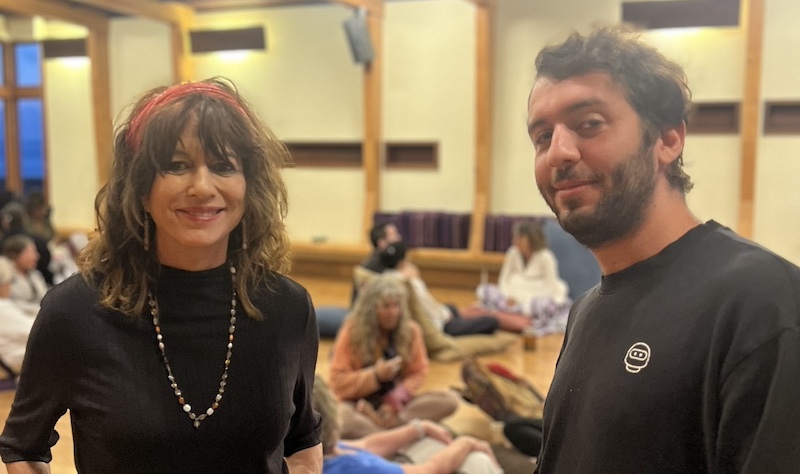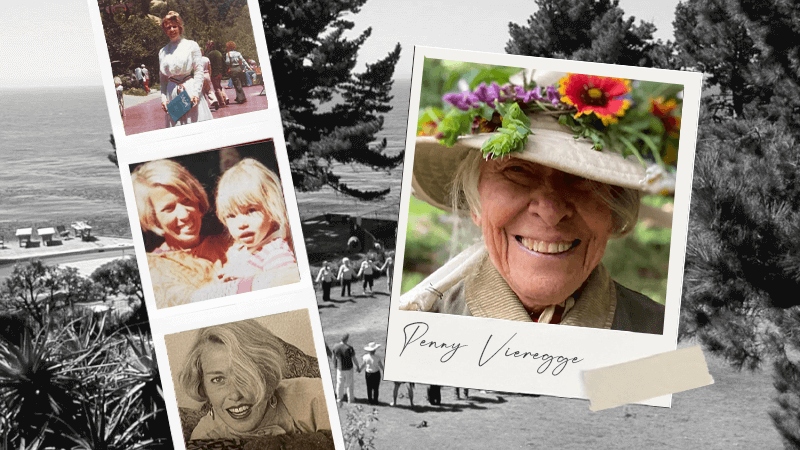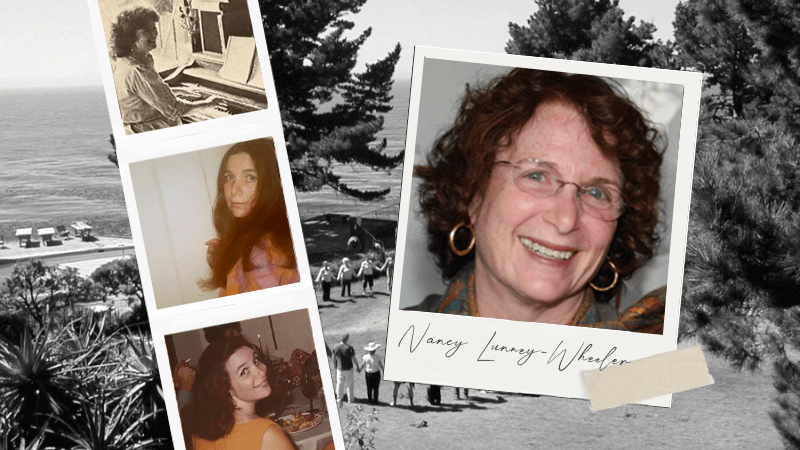
The former head of programs, the department she led for thirty years, Nancy Lunney-Wheeler reflects on the early days, the Russian-American project, Spirit Awakening, the legendary musical performances she organized on campus, and her arrival at Esalen as a young mother.
In 1968 I was living in L.A. My life was, well, the life of a 29-year-old mom in Los Angeles. I was occasionally working from home as a vocal coach and accompanist to some famous, and some not so famous actors. My husband had read a Look magazine article about Esalen, written by George Leonard, and was fixated on the place. My feeling was, “Yeah, whatever, I've got diapers to wash.” I didn't know it would change my life.
My husband took a five-day workshop, Yoga, Movement and Massage, led by Gabrielle Roth. She was nine months pregnant with Jonathan. He came back transformed. I wasn’t impressed. I was born in 1940. There wasn’t a dot of hippie in me. I wasn’t a feminist. I didn't want to know.
Fast-forward a few years. My life wasn’t what I wanted it to be — whatever that was. What I knew was I was not very happy.
The postman regularly delivered Esalen catalogs. They piled up on the coffee table next to the Desitin. I was now sort of interested. Psychology had always fascinated me, so I thought I’d take something relevant. I signed up for Gestalt Practice, taught by the Esalen Gestalt staff. The Esalen Gestalt staff then was Dick Price and his wife, Chris.
I’d never been in therapy. I learned about Freud’s couch and Pavlov’s dogs at NYU. That was about it. Gestalt Practice, especially with Dick Price, co-founder of Esalen, was – it was something. It’s hard to put into words. Some of them probably are permission, freedom, gentleness. I was able to go inside myself — for the first time — to begin to discover who I was.
I left Esalen and went home, but Esalen didn’t leave me.
Later, Janet Lederman, co-Director with Julian Silverman, urged me to come to Esalen. Just for a month, as a Work Scholar, she said. As much as I was drawn to the place, it scared me. So of course I resisted. “I can't leave my children.” Janet insisted.
“Bring them,” she said. “Like two walking suitcases." Who could argue with that?
The change was difficult, but we somehow managed. I wanted to contribute to the community. I knew how to get people to sing. I put on a musical review with the staff. The review was three and a half hours long! It got a standing ovation. Okay, it was the staff doing most of the applauding, but who’s picky?
Things had a way of falling into place. After the review, I was invited again to come for a month at a time with my children, to work with the staff through singing. Almost everyone would find their way to that music room to sing songs from their hearts while I accompanied them. Even Dick Price came to me for a few sessions. He wanted to sing the title song from the movie A Portrait of Jenny. He wanted to sing it to his little girl. One day Dick sat down next to me and said, “Well, what do you want here?”
I said: “I'd like to come here. Live here with my kids.”
He said, “Okay.”
That's how I got here. That's how I left my marriage.
Then the hard part. I had to figure out what I was going to do at Esalen, what role I could play. Putting on musical reviews was fun, but it wasn't exactly a long-term career plan. I eventually became the Head of Programs. I love connecting with people, I had an extensive network of friends in LA and New York to draw on for ideas and connections. I also love talking on the phone, I love being able to offer possibilities: Here was a place you could try things out, to explore. It was exciting.
I learned about programming from Dick. Dick wouldn’t permit academic degrees to be included in the write-ups. Forget it if somebody had a PhD; he thought a degree alone didn’t qualify you for anything. The word therapy was banned too. Dick’s view was that therapy is something that is done to you. Here, you are in charge, not a therapist. We were offering possibilities.
We scheduled a lot of what we called the “intellectual workshops,” initiatives brought in by Michael and Dulce Murphy. We had (and continue to have) amazing conferences on site through Esalen’s Center for Theory & Research. The Russian-American Project brought cosmonauts and astronauts together, leaders in medicine and other key fields, we sponsored former Russian president Boris Yeltsin’s visit to the US, and leaders from China. The list is extensive and continues to excite and expand today.
We developed other programs to extend Esalen’s reach beyond those who could afford to sign up for workshops. The Spirit Awakening program meant a lot to me. Akuyoe Graham, one of our workshop leaders, worked with underserved children in Los Angeles. I thought it would be wonderful to bring underserved young people here, to expose them to Esalen, to feel this amazing land, and have an experience they might not ever be exposed to.
Another program we hosted was with 18 Israeli women — Palestinian, Jewish, and Christian leaders of an initiative called Beyond Words. These women had never had the opportunity to sit and really talk together about their rage, pain, hopes, fears. They were hosted at Esalen for ten days, facilitated by some of our leading faculty who waived their fees. We created a space for conversations between women who worked side by side for peace, but had never sat in a room together to express all the deepest feelings of rage and pain that they could not express working together at home. Being part of this made me deeply proud.
In some ways Esalen has changed. But when I walk around the property, see and feel the ocean and the cliffs, it’s the same feeling I had all those years ago. It’s a place like no other – indelible. All of us who work here, who teach or take a workshop here, we have been changed by it. We have our Esalen.

“Remembering to be as self compassionate as I can and praying to the divine that we're all a part of.”
–Aaron
“Prayer, reading, meditation, walking.”
–Karen
“Erratically — which is an ongoing stream of practice to find peace.”
–Charles
“Try on a daily basis to be kind to myself and to realize that making mistakes is a part of the human condition. Learning from our mistakes is a journey. But it starts with compassion and caring. First for oneself.”
–Steve
“Physically: aerobic exercise, volleyball, ice hockey, cycling, sailing. Emotionally: unfortunately I have to work to ‘not care’ about people or situations which may end painfully. Along the lines of ‘attachment is the source of suffering’, so best to avoid it or limit its scope. Sad though because it could also be the source of great joy. Is it worth the risk?“
–Rainer


“It's time for my heart to be nurtured on one level yet contained on another. To go easy on me and to allow my feelings to be validated, not judged harshly. On the other hand, to let the heart rule with equanimity and not lead the mind and body around like a master.”
–Suzanne
“I spend time thinking of everything I am grateful for, and I try to develop my ability to express compassion for myself and others without reservation. I take time to do the things I need to do to keep myself healthy and happy. This includes taking experiential workshops, fostering relationships, and participating within groups which have a similar interest to become a more compassionate and fulfilled being.“
–Peter


“Self-forgiveness for my own judgments. And oh yeah, coming to Esalen.”
–David B.
“Hmm, this is a tough one! I guess I take care of my heart through fostering relationships with people I feel connected to. Spending quality time with them (whether we're on the phone, through messages/letters, on Zoom, or in-person). Being there for them, listening to them, sharing what's going on with me, my struggles and my successes... like we do in the Esalen weekly Friends of Esalen Zoom sessions!”
–Lori

“I remind myself in many ways of the fact that " Love is all there is!" LOVE is the prize and this one precious life is the stage we get to learn our lessons. I get out into nature, hike, camp, river kayak, fly fish, garden, I create, I dance (not enough!), and I remain grateful for each day, each breath, each moment. Being in the moment, awake, and remembering the gift of life and my feeling of gratitude for all of creation.”
–Steven
“My physical heart by limiting stress and eating a heart-healthy diet. My emotional heart by staying in love with the world and by knowing that all disappointment and loss will pass.“
–David Z.
Today, September 29, is World Heart Day. Strike up a conversation with your own heart and as you feel comfortable, encourage others to do the same. As part of our own transformations and self-care, we sometimes ask for others to illuminate and enliven our hearts or speak our love language.
What if we could do this for ourselves too, even if just for today… or to start a heart practice, forever?
The former head of programs, the department she led for thirty years, Nancy Lunney-Wheeler reflects on the early days, the Russian-American project, Spirit Awakening, the legendary musical performances she organized on campus, and her arrival at Esalen as a young mother.
In 1968 I was living in L.A. My life was, well, the life of a 29-year-old mom in Los Angeles. I was occasionally working from home as a vocal coach and accompanist to some famous, and some not so famous actors. My husband had read a Look magazine article about Esalen, written by George Leonard, and was fixated on the place. My feeling was, “Yeah, whatever, I've got diapers to wash.” I didn't know it would change my life.
My husband took a five-day workshop, Yoga, Movement and Massage, led by Gabrielle Roth. She was nine months pregnant with Jonathan. He came back transformed. I wasn’t impressed. I was born in 1940. There wasn’t a dot of hippie in me. I wasn’t a feminist. I didn't want to know.
Fast-forward a few years. My life wasn’t what I wanted it to be — whatever that was. What I knew was I was not very happy.
The postman regularly delivered Esalen catalogs. They piled up on the coffee table next to the Desitin. I was now sort of interested. Psychology had always fascinated me, so I thought I’d take something relevant. I signed up for Gestalt Practice, taught by the Esalen Gestalt staff. The Esalen Gestalt staff then was Dick Price and his wife, Chris.
I’d never been in therapy. I learned about Freud’s couch and Pavlov’s dogs at NYU. That was about it. Gestalt Practice, especially with Dick Price, co-founder of Esalen, was – it was something. It’s hard to put into words. Some of them probably are permission, freedom, gentleness. I was able to go inside myself — for the first time — to begin to discover who I was.
I left Esalen and went home, but Esalen didn’t leave me.
Later, Janet Lederman, co-Director with Julian Silverman, urged me to come to Esalen. Just for a month, as a Work Scholar, she said. As much as I was drawn to the place, it scared me. So of course I resisted. “I can't leave my children.” Janet insisted.
“Bring them,” she said. “Like two walking suitcases." Who could argue with that?
The change was difficult, but we somehow managed. I wanted to contribute to the community. I knew how to get people to sing. I put on a musical review with the staff. The review was three and a half hours long! It got a standing ovation. Okay, it was the staff doing most of the applauding, but who’s picky?
Things had a way of falling into place. After the review, I was invited again to come for a month at a time with my children, to work with the staff through singing. Almost everyone would find their way to that music room to sing songs from their hearts while I accompanied them. Even Dick Price came to me for a few sessions. He wanted to sing the title song from the movie A Portrait of Jenny. He wanted to sing it to his little girl. One day Dick sat down next to me and said, “Well, what do you want here?”
I said: “I'd like to come here. Live here with my kids.”
He said, “Okay.”
That's how I got here. That's how I left my marriage.
Then the hard part. I had to figure out what I was going to do at Esalen, what role I could play. Putting on musical reviews was fun, but it wasn't exactly a long-term career plan. I eventually became the Head of Programs. I love connecting with people, I had an extensive network of friends in LA and New York to draw on for ideas and connections. I also love talking on the phone, I love being able to offer possibilities: Here was a place you could try things out, to explore. It was exciting.
I learned about programming from Dick. Dick wouldn’t permit academic degrees to be included in the write-ups. Forget it if somebody had a PhD; he thought a degree alone didn’t qualify you for anything. The word therapy was banned too. Dick’s view was that therapy is something that is done to you. Here, you are in charge, not a therapist. We were offering possibilities.
We scheduled a lot of what we called the “intellectual workshops,” initiatives brought in by Michael and Dulce Murphy. We had (and continue to have) amazing conferences on site through Esalen’s Center for Theory & Research. The Russian-American Project brought cosmonauts and astronauts together, leaders in medicine and other key fields, we sponsored former Russian president Boris Yeltsin’s visit to the US, and leaders from China. The list is extensive and continues to excite and expand today.
We developed other programs to extend Esalen’s reach beyond those who could afford to sign up for workshops. The Spirit Awakening program meant a lot to me. Akuyoe Graham, one of our workshop leaders, worked with underserved children in Los Angeles. I thought it would be wonderful to bring underserved young people here, to expose them to Esalen, to feel this amazing land, and have an experience they might not ever be exposed to.
Another program we hosted was with 18 Israeli women — Palestinian, Jewish, and Christian leaders of an initiative called Beyond Words. These women had never had the opportunity to sit and really talk together about their rage, pain, hopes, fears. They were hosted at Esalen for ten days, facilitated by some of our leading faculty who waived their fees. We created a space for conversations between women who worked side by side for peace, but had never sat in a room together to express all the deepest feelings of rage and pain that they could not express working together at home. Being part of this made me deeply proud.
In some ways Esalen has changed. But when I walk around the property, see and feel the ocean and the cliffs, it’s the same feeling I had all those years ago. It’s a place like no other – indelible. All of us who work here, who teach or take a workshop here, we have been changed by it. We have our Esalen.
“Remembering to be as self compassionate as I can and praying to the divine that we're all a part of.”
–Aaron
“Prayer, reading, meditation, walking.”
–Karen
“Erratically — which is an ongoing stream of practice to find peace.”
–Charles
“Try on a daily basis to be kind to myself and to realize that making mistakes is a part of the human condition. Learning from our mistakes is a journey. But it starts with compassion and caring. First for oneself.”
–Steve
“Physically: aerobic exercise, volleyball, ice hockey, cycling, sailing. Emotionally: unfortunately I have to work to ‘not care’ about people or situations which may end painfully. Along the lines of ‘attachment is the source of suffering’, so best to avoid it or limit its scope. Sad though because it could also be the source of great joy. Is it worth the risk?“
–Rainer
“It's time for my heart to be nurtured on one level yet contained on another. To go easy on me and to allow my feelings to be validated, not judged harshly. On the other hand, to let the heart rule with equanimity and not lead the mind and body around like a master.”
–Suzanne
“I spend time thinking of everything I am grateful for, and I try to develop my ability to express compassion for myself and others without reservation. I take time to do the things I need to do to keep myself healthy and happy. This includes taking experiential workshops, fostering relationships, and participating within groups which have a similar interest to become a more compassionate and fulfilled being.“
–Peter
“Self-forgiveness for my own judgments. And oh yeah, coming to Esalen.”
–David B.
“Hmm, this is a tough one! I guess I take care of my heart through fostering relationships with people I feel connected to. Spending quality time with them (whether we're on the phone, through messages/letters, on Zoom, or in-person). Being there for them, listening to them, sharing what's going on with me, my struggles and my successes... like we do in the Esalen weekly Friends of Esalen Zoom sessions!”
–Lori
“I remind myself in many ways of the fact that " Love is all there is!" LOVE is the prize and this one precious life is the stage we get to learn our lessons. I get out into nature, hike, camp, river kayak, fly fish, garden, I create, I dance (not enough!), and I remain grateful for each day, each breath, each moment. Being in the moment, awake, and remembering the gift of life and my feeling of gratitude for all of creation.”
–Steven
“My physical heart by limiting stress and eating a heart-healthy diet. My emotional heart by staying in love with the world and by knowing that all disappointment and loss will pass.“
–David Z.
Today, September 29, is World Heart Day. Strike up a conversation with your own heart and as you feel comfortable, encourage others to do the same. As part of our own transformations and self-care, we sometimes ask for others to illuminate and enliven our hearts or speak our love language.
What if we could do this for ourselves too, even if just for today… or to start a heart practice, forever?
The former head of programs, the department she led for thirty years, Nancy Lunney-Wheeler reflects on the early days, the Russian-American project, Spirit Awakening, the legendary musical performances she organized on campus, and her arrival at Esalen as a young mother.
In 1968 I was living in L.A. My life was, well, the life of a 29-year-old mom in Los Angeles. I was occasionally working from home as a vocal coach and accompanist to some famous, and some not so famous actors. My husband had read a Look magazine article about Esalen, written by George Leonard, and was fixated on the place. My feeling was, “Yeah, whatever, I've got diapers to wash.” I didn't know it would change my life.
My husband took a five-day workshop, Yoga, Movement and Massage, led by Gabrielle Roth. She was nine months pregnant with Jonathan. He came back transformed. I wasn’t impressed. I was born in 1940. There wasn’t a dot of hippie in me. I wasn’t a feminist. I didn't want to know.
Fast-forward a few years. My life wasn’t what I wanted it to be — whatever that was. What I knew was I was not very happy.
The postman regularly delivered Esalen catalogs. They piled up on the coffee table next to the Desitin. I was now sort of interested. Psychology had always fascinated me, so I thought I’d take something relevant. I signed up for Gestalt Practice, taught by the Esalen Gestalt staff. The Esalen Gestalt staff then was Dick Price and his wife, Chris.
I’d never been in therapy. I learned about Freud’s couch and Pavlov’s dogs at NYU. That was about it. Gestalt Practice, especially with Dick Price, co-founder of Esalen, was – it was something. It’s hard to put into words. Some of them probably are permission, freedom, gentleness. I was able to go inside myself — for the first time — to begin to discover who I was.
I left Esalen and went home, but Esalen didn’t leave me.
Later, Janet Lederman, co-Director with Julian Silverman, urged me to come to Esalen. Just for a month, as a Work Scholar, she said. As much as I was drawn to the place, it scared me. So of course I resisted. “I can't leave my children.” Janet insisted.
“Bring them,” she said. “Like two walking suitcases." Who could argue with that?
The change was difficult, but we somehow managed. I wanted to contribute to the community. I knew how to get people to sing. I put on a musical review with the staff. The review was three and a half hours long! It got a standing ovation. Okay, it was the staff doing most of the applauding, but who’s picky?
Things had a way of falling into place. After the review, I was invited again to come for a month at a time with my children, to work with the staff through singing. Almost everyone would find their way to that music room to sing songs from their hearts while I accompanied them. Even Dick Price came to me for a few sessions. He wanted to sing the title song from the movie A Portrait of Jenny. He wanted to sing it to his little girl. One day Dick sat down next to me and said, “Well, what do you want here?”
I said: “I'd like to come here. Live here with my kids.”
He said, “Okay.”
That's how I got here. That's how I left my marriage.
Then the hard part. I had to figure out what I was going to do at Esalen, what role I could play. Putting on musical reviews was fun, but it wasn't exactly a long-term career plan. I eventually became the Head of Programs. I love connecting with people, I had an extensive network of friends in LA and New York to draw on for ideas and connections. I also love talking on the phone, I love being able to offer possibilities: Here was a place you could try things out, to explore. It was exciting.
I learned about programming from Dick. Dick wouldn’t permit academic degrees to be included in the write-ups. Forget it if somebody had a PhD; he thought a degree alone didn’t qualify you for anything. The word therapy was banned too. Dick’s view was that therapy is something that is done to you. Here, you are in charge, not a therapist. We were offering possibilities.
We scheduled a lot of what we called the “intellectual workshops,” initiatives brought in by Michael and Dulce Murphy. We had (and continue to have) amazing conferences on site through Esalen’s Center for Theory & Research. The Russian-American Project brought cosmonauts and astronauts together, leaders in medicine and other key fields, we sponsored former Russian president Boris Yeltsin’s visit to the US, and leaders from China. The list is extensive and continues to excite and expand today.
We developed other programs to extend Esalen’s reach beyond those who could afford to sign up for workshops. The Spirit Awakening program meant a lot to me. Akuyoe Graham, one of our workshop leaders, worked with underserved children in Los Angeles. I thought it would be wonderful to bring underserved young people here, to expose them to Esalen, to feel this amazing land, and have an experience they might not ever be exposed to.
Another program we hosted was with 18 Israeli women — Palestinian, Jewish, and Christian leaders of an initiative called Beyond Words. These women had never had the opportunity to sit and really talk together about their rage, pain, hopes, fears. They were hosted at Esalen for ten days, facilitated by some of our leading faculty who waived their fees. We created a space for conversations between women who worked side by side for peace, but had never sat in a room together to express all the deepest feelings of rage and pain that they could not express working together at home. Being part of this made me deeply proud.
In some ways Esalen has changed. But when I walk around the property, see and feel the ocean and the cliffs, it’s the same feeling I had all those years ago. It’s a place like no other – indelible. All of us who work here, who teach or take a workshop here, we have been changed by it. We have our Esalen.
“Remembering to be as self compassionate as I can and praying to the divine that we're all a part of.”
–Aaron
“Prayer, reading, meditation, walking.”
–Karen
“Erratically — which is an ongoing stream of practice to find peace.”
–Charles
“Try on a daily basis to be kind to myself and to realize that making mistakes is a part of the human condition. Learning from our mistakes is a journey. But it starts with compassion and caring. First for oneself.”
–Steve
“Physically: aerobic exercise, volleyball, ice hockey, cycling, sailing. Emotionally: unfortunately I have to work to ‘not care’ about people or situations which may end painfully. Along the lines of ‘attachment is the source of suffering’, so best to avoid it or limit its scope. Sad though because it could also be the source of great joy. Is it worth the risk?“
–Rainer
“It's time for my heart to be nurtured on one level yet contained on another. To go easy on me and to allow my feelings to be validated, not judged harshly. On the other hand, to let the heart rule with equanimity and not lead the mind and body around like a master.”
–Suzanne
“I spend time thinking of everything I am grateful for, and I try to develop my ability to express compassion for myself and others without reservation. I take time to do the things I need to do to keep myself healthy and happy. This includes taking experiential workshops, fostering relationships, and participating within groups which have a similar interest to become a more compassionate and fulfilled being.“
–Peter
“Self-forgiveness for my own judgments. And oh yeah, coming to Esalen.”
–David B.
“Hmm, this is a tough one! I guess I take care of my heart through fostering relationships with people I feel connected to. Spending quality time with them (whether we're on the phone, through messages/letters, on Zoom, or in-person). Being there for them, listening to them, sharing what's going on with me, my struggles and my successes... like we do in the Esalen weekly Friends of Esalen Zoom sessions!”
–Lori
“I remind myself in many ways of the fact that " Love is all there is!" LOVE is the prize and this one precious life is the stage we get to learn our lessons. I get out into nature, hike, camp, river kayak, fly fish, garden, I create, I dance (not enough!), and I remain grateful for each day, each breath, each moment. Being in the moment, awake, and remembering the gift of life and my feeling of gratitude for all of creation.”
–Steven
“My physical heart by limiting stress and eating a heart-healthy diet. My emotional heart by staying in love with the world and by knowing that all disappointment and loss will pass.“
–David Z.
Today, September 29, is World Heart Day. Strike up a conversation with your own heart and as you feel comfortable, encourage others to do the same. As part of our own transformations and self-care, we sometimes ask for others to illuminate and enliven our hearts or speak our love language.
What if we could do this for ourselves too, even if just for today… or to start a heart practice, forever?
Esalen Institute
55000 Highway 1
Big Sur, CA 93920

US: 1-831-667-3000

info@esalen.org