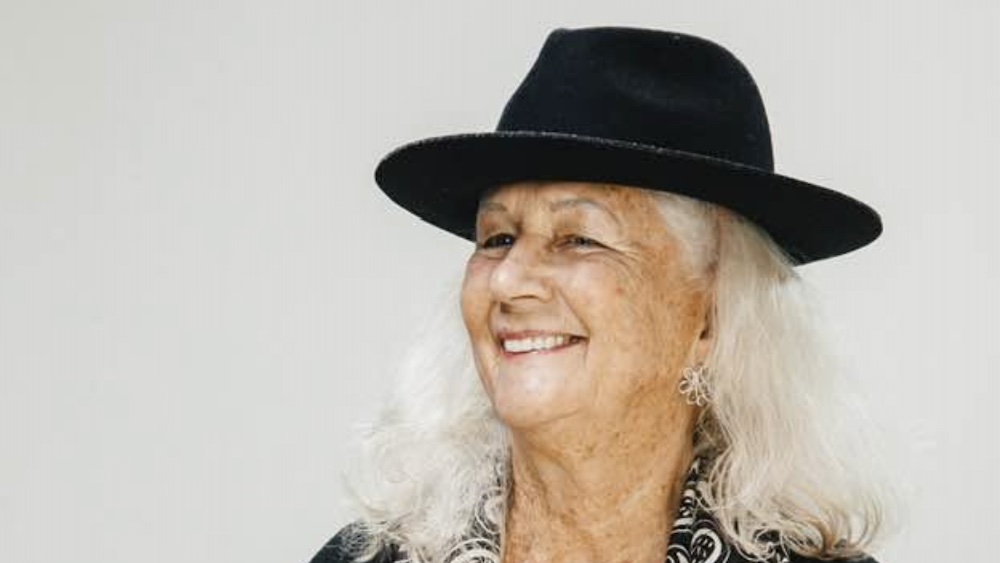
Ellen Watson arrived in 1984, not knowing that her exploration of Gestalt, breathwork, dance, expanded states of consciousness, and hands-on healing would shape the course of her life: “I arrived at Esalen needing healing in every way possible. Emotionally, psychologically, spiritually, me, everything.” The longtime faculty member and community leader reminisces on the teachers, practices, and unexpected discoveries that drew her in and kept her coming back for decades: “I began to think of Esalen as an unaccredited graduate school in universal consciousness study.” (To hear Ellen tell this story, listen to her conversation with Voices of Esalen)
I first arrived at Esalen in the summer of 1984. My sister-in-law had one day put me on a plane and said, “You’re going to Esalen. It doesn’t matter what you take.”
I immediately felt a sense of freedom when I saw the expanse of the Pacific. That expansive feeling continued everywhere I went. My first workshop was in the Murphy House, and I got to stay there. I fell in love with that old house. I felt like it was my house.
I stayed for two weeks and took four workshops. Holotropic breathwork with Stan Grof and Gestalt with Seymour Carter both grabbed me. Stan opened up a whole new world for me, partly because of who he was and how he talked about his work. Gestalt brought a kind of honesty and presence that nothing else did.
I was busy being very cute, you know, Southern and cute, and avoiding talking about what was really real underneath. I was used to putting on the happy face and being the cheerleader type, and I had a huge amount going on internally that needed addressing.
Seymour kept asking me, “What are you avoiding?”
I returned as a work scholar, driving my little Volkswagen to Big Sur. I thought I’d stay a few months. I stayed for more than 20 years.
I did Gestalt with anyone offering it, whether visiting teachers or people working at Esalen, including Dick and Chris Price and Seymour. I was also drawn to anything involving breath and sound. I began to think of Esalen as an unaccredited graduate school in universal consciousness study.
Emilee Conrad’s Continuum work was new then, coming out of a lab in Los Angeles. The programs weren’t booking well, so those of us working at Esalen sometimes filled the spaces and got three-week immersions.
The work involved breath, sound, and undulation. The intention was to return to the amniotic state. That was the overlay: that we emerged from the ocean at some point in our evolutionary history.
Your only job was to lie on your mat. You couldn’t stand, but you could lie down, crawl, or do whatever you wanted on the floor. You worked with initiating movement through breath, sound, and intention. You might even work on moving the center of the palm of your hand without moving the hand itself. It was basically hot-wiring the neural pathways of the central nervous system.
Emilee was an intellectual. She wasn’t particularly interested in how people felt. She was interested in helping people move through that and discover a deeper aspect of themselves than the emotional layer. All of that was fascinating to me.
I studied breath with everyone doing anything related to breath. I was in love with Gabrielle Roth from the get-go. Gabrielle and Stan Grof were major influences on me in breath, sound, music, movement, and the body.
Sometimes we danced for three or four hours in a morning 5Rhythms® session. With Gabrielle, there might be live music, and we’d warm up to recorded music before moving into the dance. The intention was to get out of linear thinking and into a highly experiential state. It could be transformative, taking you into a non-ordinary state of consciousness for intense healing.
I had some of my most profound experiences on the dance floor. Gabrielle’s work wasn’t directly medicine work, but it arose from it. Everything I was deeply drawn to had the permission to contact, explore, and express the agony and the ecstasy, that range between, and to die and be reborn hundreds of times.
Sometimes people would reenter trauma or personal history that hadn’t been cleared. The thing was to keep moving. Don’t hole up in a corner. Keep moving, keep breathing, keep your eyes open. Have a grounded, in-the-moment experience while the body memory reemerges and gets integrated, turned into art.
Nancy Lunney was a program director who lived at Esalen, and she held a singing Gestalt class every Wednesday afternoon. Before Esalen, she had been a voice coach, pianist, and piano teacher. She could listen to the first three notes and know how to lead by following. She was also a psychologist specializing in Gestalt, and she combined the two in a way I’d never encountered.
When I was young, a church choir director had traumatized me by telling me to lip-sync. So I went to Nancy’s singing Gestalt class for almost 10 years while living on campus and working at Esalen every day.
That practice is not about performance. It’s about how you feel.
In the 1980s, there were open seats with Dick Price three or four times a week. I saw what people could do when they had the freedom to express themselves. Under strong, supportive leadership, I jumped in.
David Steindl-Rast had a profound effect on me. He was a Benedictine Christian monk who lived at the Hermitage and could talk about Zen, Christianity, and other religions, building remarkable bridges between them. He took MDMA and said that monks meditate for years trying to feel that way.
I loved him. He was loving, caring, and extraordinarily well-informed. He read the original texts of holy books and knew Aramaic and Greek. Eventually, I co-led workshops with him.
I arrived at Esalen in the early 1980s, when the door on psychedelics was beginning to close. Under the tutelage of Stan Grof and Terence McKenna, I took certain mind-expanding and heart-opening medicines, not recreationally, but for clearing. The idea was to clear out inner space so our capacity to hold space for ourselves or others wasn’t cluttered.
I met Terence [McKenna] in a circle at a friend’s place in Ojai. He brought something called Little Smoke, a combination of seven plant medicines.
Terence was, among other things, an unparalleled wordsmith. He had a command of the English language like very few people have. I found him, in addition to being brilliant and very cerebral, quite heartful. He drove around in a 20-year-old car. He didn’t believe in collecting material things. And I’ll just say he was essentially a very good human.
My experience with Little Smoke was such a profound, multisensory, utterly delightful experience: seeing music and hearing music notes at the same time, having plants talk to me, experiencing myself as delicious. Not with any connotation of what that meant, but I realized I was delicious.
The friend sitting for me knew there was more available, so I got a double dose with enhancers. I went into a major healing for eight hours, where I worked through the release of the physicality of the traumas I had experienced to that date.
Through the process of alchemy, transformation is possible. Beneath that is deep relaxation, and the whole nervous system can recalibrate, so there’s a sense of renewal. We don’t have to have the aha of the universe every time.
I became an Esalen® Massage practitioner, teacher, and trainer of teachers. Esalen Massage is a non-ordinary state of consciousness. Both the giver and the receiver are wrapped in a web. I spin a web around us of safety so that the relationship between the two of us is not interfered with by anything outside of us.
I had wonderful massage teachers. There were 20 people on the faculty of one in-house training, and we all disagreed. It was wonderful.
I tried everything: chanting, vocalizing, yoga, kirtan, mantra, whatever was available in the lineage. I became a thousand-hour yoga teacher. All of that got woven into the hands-on healing arts.
I read The Relaxation Response and became interested in what happens when a practitioner, or the person receiving the work, drops deeply into the nervous system. If the parasympathetic nervous system and the watchdog that lives there can go to sleep and take a rest, then one can heal oneself with nothing from the outside.
Esalen Massage is a profound philosophy that includes relationship. We cultivate a relationship. We’re not fixing anyone.
When you have a well-intended visionary energy worker, massage person, or healing artist, the chances of having remarkable experiences are pretty good.
When the weather allowed, we worked mostly outside. I wanted the work to be multisensory, multicultural, neo-shamanic. I added invocation, prayer, and benediction. I realized this was my ministerial offering, the laying on of hands. I appreciated being able to bring metaphysics into the experience of touching human skin.
I arrived at Esalen needing healing in every way possible. Emotionally, psychologically, spiritually, me, everything.
A colleague in the kitchen once said to me, ‘There’s nothing really wrong with you, Ellen. You’re just emotionally [stunted].’
I didn’t know what I was feeling when I was feeling it, and I didn’t have permission to express it. That’s what I learned at Esalen.
Whether it was through medicine, dance, Holotropic breathwork, or hands-on healing, Esalen gave me access to things I never knew existed. The exposure to the wide variety of what was available at the time changed the trajectory of my life immeasurably.”

“Remembering to be as self compassionate as I can and praying to the divine that we're all a part of.”
–Aaron
“Prayer, reading, meditation, walking.”
–Karen
“Erratically — which is an ongoing stream of practice to find peace.”
–Charles
“Try on a daily basis to be kind to myself and to realize that making mistakes is a part of the human condition. Learning from our mistakes is a journey. But it starts with compassion and caring. First for oneself.”
–Steve
“Physically: aerobic exercise, volleyball, ice hockey, cycling, sailing. Emotionally: unfortunately I have to work to ‘not care’ about people or situations which may end painfully. Along the lines of ‘attachment is the source of suffering’, so best to avoid it or limit its scope. Sad though because it could also be the source of great joy. Is it worth the risk?“
–Rainer


“It's time for my heart to be nurtured on one level yet contained on another. To go easy on me and to allow my feelings to be validated, not judged harshly. On the other hand, to let the heart rule with equanimity and not lead the mind and body around like a master.”
–Suzanne
“I spend time thinking of everything I am grateful for, and I try to develop my ability to express compassion for myself and others without reservation. I take time to do the things I need to do to keep myself healthy and happy. This includes taking experiential workshops, fostering relationships, and participating within groups which have a similar interest to become a more compassionate and fulfilled being.“
–Peter


“Self-forgiveness for my own judgments. And oh yeah, coming to Esalen.”
–David B.
“Hmm, this is a tough one! I guess I take care of my heart through fostering relationships with people I feel connected to. Spending quality time with them (whether we're on the phone, through messages/letters, on Zoom, or in-person). Being there for them, listening to them, sharing what's going on with me, my struggles and my successes... like we do in the Esalen weekly Friends of Esalen Zoom sessions!”
–Lori

“I remind myself in many ways of the fact that " Love is all there is!" LOVE is the prize and this one precious life is the stage we get to learn our lessons. I get out into nature, hike, camp, river kayak, fly fish, garden, I create, I dance (not enough!), and I remain grateful for each day, each breath, each moment. Being in the moment, awake, and remembering the gift of life and my feeling of gratitude for all of creation.”
–Steven
“My physical heart by limiting stress and eating a heart-healthy diet. My emotional heart by staying in love with the world and by knowing that all disappointment and loss will pass.“
–David Z.
Today, September 29, is World Heart Day. Strike up a conversation with your own heart and as you feel comfortable, encourage others to do the same. As part of our own transformations and self-care, we sometimes ask for others to illuminate and enliven our hearts or speak our love language.
What if we could do this for ourselves too, even if just for today… or to start a heart practice, forever?
Ellen Watson arrived in 1984, not knowing that her exploration of Gestalt, breathwork, dance, expanded states of consciousness, and hands-on healing would shape the course of her life: “I arrived at Esalen needing healing in every way possible. Emotionally, psychologically, spiritually, me, everything.” The longtime faculty member and community leader reminisces on the teachers, practices, and unexpected discoveries that drew her in and kept her coming back for decades: “I began to think of Esalen as an unaccredited graduate school in universal consciousness study.” (To hear Ellen tell this story, listen to her conversation with Voices of Esalen)
I first arrived at Esalen in the summer of 1984. My sister-in-law had one day put me on a plane and said, “You’re going to Esalen. It doesn’t matter what you take.”
I immediately felt a sense of freedom when I saw the expanse of the Pacific. That expansive feeling continued everywhere I went. My first workshop was in the Murphy House, and I got to stay there. I fell in love with that old house. I felt like it was my house.
I stayed for two weeks and took four workshops. Holotropic breathwork with Stan Grof and Gestalt with Seymour Carter both grabbed me. Stan opened up a whole new world for me, partly because of who he was and how he talked about his work. Gestalt brought a kind of honesty and presence that nothing else did.
I was busy being very cute, you know, Southern and cute, and avoiding talking about what was really real underneath. I was used to putting on the happy face and being the cheerleader type, and I had a huge amount going on internally that needed addressing.
Seymour kept asking me, “What are you avoiding?”
I returned as a work scholar, driving my little Volkswagen to Big Sur. I thought I’d stay a few months. I stayed for more than 20 years.
I did Gestalt with anyone offering it, whether visiting teachers or people working at Esalen, including Dick and Chris Price and Seymour. I was also drawn to anything involving breath and sound. I began to think of Esalen as an unaccredited graduate school in universal consciousness study.
Emilee Conrad’s Continuum work was new then, coming out of a lab in Los Angeles. The programs weren’t booking well, so those of us working at Esalen sometimes filled the spaces and got three-week immersions.
The work involved breath, sound, and undulation. The intention was to return to the amniotic state. That was the overlay: that we emerged from the ocean at some point in our evolutionary history.
Your only job was to lie on your mat. You couldn’t stand, but you could lie down, crawl, or do whatever you wanted on the floor. You worked with initiating movement through breath, sound, and intention. You might even work on moving the center of the palm of your hand without moving the hand itself. It was basically hot-wiring the neural pathways of the central nervous system.
Emilee was an intellectual. She wasn’t particularly interested in how people felt. She was interested in helping people move through that and discover a deeper aspect of themselves than the emotional layer. All of that was fascinating to me.
I studied breath with everyone doing anything related to breath. I was in love with Gabrielle Roth from the get-go. Gabrielle and Stan Grof were major influences on me in breath, sound, music, movement, and the body.
Sometimes we danced for three or four hours in a morning 5Rhythms® session. With Gabrielle, there might be live music, and we’d warm up to recorded music before moving into the dance. The intention was to get out of linear thinking and into a highly experiential state. It could be transformative, taking you into a non-ordinary state of consciousness for intense healing.
I had some of my most profound experiences on the dance floor. Gabrielle’s work wasn’t directly medicine work, but it arose from it. Everything I was deeply drawn to had the permission to contact, explore, and express the agony and the ecstasy, that range between, and to die and be reborn hundreds of times.
Sometimes people would reenter trauma or personal history that hadn’t been cleared. The thing was to keep moving. Don’t hole up in a corner. Keep moving, keep breathing, keep your eyes open. Have a grounded, in-the-moment experience while the body memory reemerges and gets integrated, turned into art.
Nancy Lunney was a program director who lived at Esalen, and she held a singing Gestalt class every Wednesday afternoon. Before Esalen, she had been a voice coach, pianist, and piano teacher. She could listen to the first three notes and know how to lead by following. She was also a psychologist specializing in Gestalt, and she combined the two in a way I’d never encountered.
When I was young, a church choir director had traumatized me by telling me to lip-sync. So I went to Nancy’s singing Gestalt class for almost 10 years while living on campus and working at Esalen every day.
That practice is not about performance. It’s about how you feel.
In the 1980s, there were open seats with Dick Price three or four times a week. I saw what people could do when they had the freedom to express themselves. Under strong, supportive leadership, I jumped in.
David Steindl-Rast had a profound effect on me. He was a Benedictine Christian monk who lived at the Hermitage and could talk about Zen, Christianity, and other religions, building remarkable bridges between them. He took MDMA and said that monks meditate for years trying to feel that way.
I loved him. He was loving, caring, and extraordinarily well-informed. He read the original texts of holy books and knew Aramaic and Greek. Eventually, I co-led workshops with him.
I arrived at Esalen in the early 1980s, when the door on psychedelics was beginning to close. Under the tutelage of Stan Grof and Terence McKenna, I took certain mind-expanding and heart-opening medicines, not recreationally, but for clearing. The idea was to clear out inner space so our capacity to hold space for ourselves or others wasn’t cluttered.
I met Terence [McKenna] in a circle at a friend’s place in Ojai. He brought something called Little Smoke, a combination of seven plant medicines.
Terence was, among other things, an unparalleled wordsmith. He had a command of the English language like very few people have. I found him, in addition to being brilliant and very cerebral, quite heartful. He drove around in a 20-year-old car. He didn’t believe in collecting material things. And I’ll just say he was essentially a very good human.
My experience with Little Smoke was such a profound, multisensory, utterly delightful experience: seeing music and hearing music notes at the same time, having plants talk to me, experiencing myself as delicious. Not with any connotation of what that meant, but I realized I was delicious.
The friend sitting for me knew there was more available, so I got a double dose with enhancers. I went into a major healing for eight hours, where I worked through the release of the physicality of the traumas I had experienced to that date.
Through the process of alchemy, transformation is possible. Beneath that is deep relaxation, and the whole nervous system can recalibrate, so there’s a sense of renewal. We don’t have to have the aha of the universe every time.
I became an Esalen® Massage practitioner, teacher, and trainer of teachers. Esalen Massage is a non-ordinary state of consciousness. Both the giver and the receiver are wrapped in a web. I spin a web around us of safety so that the relationship between the two of us is not interfered with by anything outside of us.
I had wonderful massage teachers. There were 20 people on the faculty of one in-house training, and we all disagreed. It was wonderful.
I tried everything: chanting, vocalizing, yoga, kirtan, mantra, whatever was available in the lineage. I became a thousand-hour yoga teacher. All of that got woven into the hands-on healing arts.
I read The Relaxation Response and became interested in what happens when a practitioner, or the person receiving the work, drops deeply into the nervous system. If the parasympathetic nervous system and the watchdog that lives there can go to sleep and take a rest, then one can heal oneself with nothing from the outside.
Esalen Massage is a profound philosophy that includes relationship. We cultivate a relationship. We’re not fixing anyone.
When you have a well-intended visionary energy worker, massage person, or healing artist, the chances of having remarkable experiences are pretty good.
When the weather allowed, we worked mostly outside. I wanted the work to be multisensory, multicultural, neo-shamanic. I added invocation, prayer, and benediction. I realized this was my ministerial offering, the laying on of hands. I appreciated being able to bring metaphysics into the experience of touching human skin.
I arrived at Esalen needing healing in every way possible. Emotionally, psychologically, spiritually, me, everything.
A colleague in the kitchen once said to me, ‘There’s nothing really wrong with you, Ellen. You’re just emotionally [stunted].’
I didn’t know what I was feeling when I was feeling it, and I didn’t have permission to express it. That’s what I learned at Esalen.
Whether it was through medicine, dance, Holotropic breathwork, or hands-on healing, Esalen gave me access to things I never knew existed. The exposure to the wide variety of what was available at the time changed the trajectory of my life immeasurably.”
“Remembering to be as self compassionate as I can and praying to the divine that we're all a part of.”
–Aaron
“Prayer, reading, meditation, walking.”
–Karen
“Erratically — which is an ongoing stream of practice to find peace.”
–Charles
“Try on a daily basis to be kind to myself and to realize that making mistakes is a part of the human condition. Learning from our mistakes is a journey. But it starts with compassion and caring. First for oneself.”
–Steve
“Physically: aerobic exercise, volleyball, ice hockey, cycling, sailing. Emotionally: unfortunately I have to work to ‘not care’ about people or situations which may end painfully. Along the lines of ‘attachment is the source of suffering’, so best to avoid it or limit its scope. Sad though because it could also be the source of great joy. Is it worth the risk?“
–Rainer
“It's time for my heart to be nurtured on one level yet contained on another. To go easy on me and to allow my feelings to be validated, not judged harshly. On the other hand, to let the heart rule with equanimity and not lead the mind and body around like a master.”
–Suzanne
“I spend time thinking of everything I am grateful for, and I try to develop my ability to express compassion for myself and others without reservation. I take time to do the things I need to do to keep myself healthy and happy. This includes taking experiential workshops, fostering relationships, and participating within groups which have a similar interest to become a more compassionate and fulfilled being.“
–Peter
“Self-forgiveness for my own judgments. And oh yeah, coming to Esalen.”
–David B.
“Hmm, this is a tough one! I guess I take care of my heart through fostering relationships with people I feel connected to. Spending quality time with them (whether we're on the phone, through messages/letters, on Zoom, or in-person). Being there for them, listening to them, sharing what's going on with me, my struggles and my successes... like we do in the Esalen weekly Friends of Esalen Zoom sessions!”
–Lori
“I remind myself in many ways of the fact that " Love is all there is!" LOVE is the prize and this one precious life is the stage we get to learn our lessons. I get out into nature, hike, camp, river kayak, fly fish, garden, I create, I dance (not enough!), and I remain grateful for each day, each breath, each moment. Being in the moment, awake, and remembering the gift of life and my feeling of gratitude for all of creation.”
–Steven
“My physical heart by limiting stress and eating a heart-healthy diet. My emotional heart by staying in love with the world and by knowing that all disappointment and loss will pass.“
–David Z.
Today, September 29, is World Heart Day. Strike up a conversation with your own heart and as you feel comfortable, encourage others to do the same. As part of our own transformations and self-care, we sometimes ask for others to illuminate and enliven our hearts or speak our love language.
What if we could do this for ourselves too, even if just for today… or to start a heart practice, forever?
Esalen Institute
55000 Highway 1
Big Sur, CA 93920

US: 1-831-667-3000

info@esalen.org