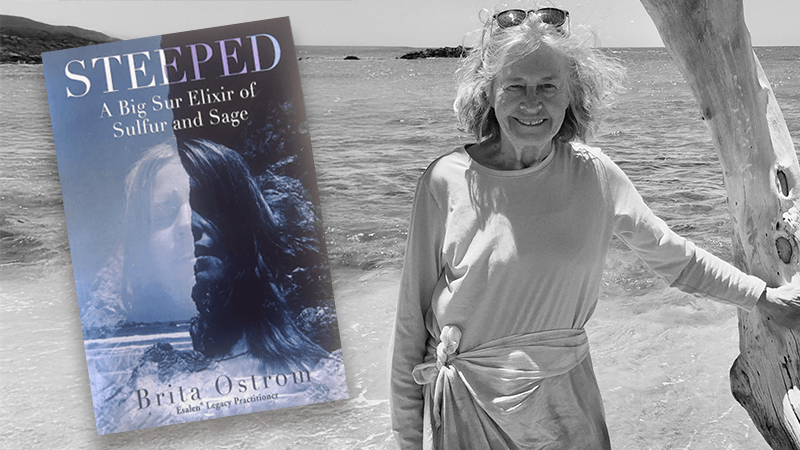
This month, our Esalen Book Club is savoring a singular story from a pioneering voice in Esalen® Massage and the human potential movement. In her new memoir, Brita reflects on a pivotal moment in Esalen history — when self-discovery, radical connection, and embodied awareness expanded the boundaries of what was possible: “We are wilder than we know, able to ford deep streams, get naked, and strong enough to lend a hand at the steep spots.”
This memoir by a longtime Esalen practitioner, massage educator, and psychotherapist revisits a brief but consequential period in Esalen’s early life: the years 1967–68. In Steeped, Brita Ostrom traces her departure from a conventional path toward what she describes as “a lifestyle centered on self-discovery, alternative relationships, and body awareness in a remote wilderness setting,” a shift that brought her both with and without her husband to the cliffs of Big Sur. She has remained at Esalen for more than five decades, teaching a somatic practice grounded in attention, presence, and touch.
Within this story of transformation there is a refreshing skepticism of the moral clarity often associated with the era. Reflecting on her involvement in the anti-war movement, Brita recalls how calls for peace often led to an inability to listen. “If we couldn’t talk to each other,” she writes, “how could we talk to Russia?” The question unsettled her enough to prompt a change in direction. She set aside what she calls her “social worker persona,” oriented toward helping others, and turned inward, toward a terrain she sensed existed but for which she had no map.
That turn parallels the ethos emerging at Esalen itself, where experimentation often preceded explanation and personal transformation was treated as a form of cultural inquiry. Brita’s portrait of Esalen co-founder Dick Price is notably embodied: she marks the softening of his jaw, the loosening of his shoulders, as he worked to undo the effects of earlier psychiatric treatment and immersed himself in Gestalt practice. When Fritz Perls left the United States near the end of the decade, disillusioned with its politics, Price assumed a central role in shaping a more egalitarian, improvisational approach that would come to define Esalen’s culture.
Brita writes without mythologizing these years, attentive to their audacity and their limits. “Writing this book to the final ‘the end’ forced me to my knees in admiration for the canyon-wide leap taken by Esalen visionaries and their families,” she notes, even as she acknowledges the instability of memory and the temptation to keep revising the past.
Steeped is both a moving personal tale and a profound meditation on the costs of self-examination. Its quiet provocation is that cultural movements falter when inner work is treated as secondary or indulgent. That claim, rooted in the 1960s, remains uncomfortably relevant now, and should be a lesson for every era.
To mark her achievement, we’re celebrating the many decades of Brita’s story at the Institute with her 2020 interview and video with Esalen community elder and longtime friend, Ken Dychtwald. After that, check out Brita’s Back in the Day with more on her initial Esalen years, including her first impressions of this extraordinary land, all the “movers and shakers” she found, and that late ’60s counterculture vibe: “It was also super funky … it was both this lavishly gorgeous place and a place that I could tell was going to be a bit of a scene.”

“Remembering to be as self compassionate as I can and praying to the divine that we're all a part of.”
–Aaron
“Prayer, reading, meditation, walking.”
–Karen
“Erratically — which is an ongoing stream of practice to find peace.”
–Charles
“Try on a daily basis to be kind to myself and to realize that making mistakes is a part of the human condition. Learning from our mistakes is a journey. But it starts with compassion and caring. First for oneself.”
–Steve
“Physically: aerobic exercise, volleyball, ice hockey, cycling, sailing. Emotionally: unfortunately I have to work to ‘not care’ about people or situations which may end painfully. Along the lines of ‘attachment is the source of suffering’, so best to avoid it or limit its scope. Sad though because it could also be the source of great joy. Is it worth the risk?“
–Rainer


“It's time for my heart to be nurtured on one level yet contained on another. To go easy on me and to allow my feelings to be validated, not judged harshly. On the other hand, to let the heart rule with equanimity and not lead the mind and body around like a master.”
–Suzanne
“I spend time thinking of everything I am grateful for, and I try to develop my ability to express compassion for myself and others without reservation. I take time to do the things I need to do to keep myself healthy and happy. This includes taking experiential workshops, fostering relationships, and participating within groups which have a similar interest to become a more compassionate and fulfilled being.“
–Peter


“Self-forgiveness for my own judgments. And oh yeah, coming to Esalen.”
–David B.
“Hmm, this is a tough one! I guess I take care of my heart through fostering relationships with people I feel connected to. Spending quality time with them (whether we're on the phone, through messages/letters, on Zoom, or in-person). Being there for them, listening to them, sharing what's going on with me, my struggles and my successes... like we do in the Esalen weekly Friends of Esalen Zoom sessions!”
–Lori

“I remind myself in many ways of the fact that " Love is all there is!" LOVE is the prize and this one precious life is the stage we get to learn our lessons. I get out into nature, hike, camp, river kayak, fly fish, garden, I create, I dance (not enough!), and I remain grateful for each day, each breath, each moment. Being in the moment, awake, and remembering the gift of life and my feeling of gratitude for all of creation.”
–Steven
“My physical heart by limiting stress and eating a heart-healthy diet. My emotional heart by staying in love with the world and by knowing that all disappointment and loss will pass.“
–David Z.
Today, September 29, is World Heart Day. Strike up a conversation with your own heart and as you feel comfortable, encourage others to do the same. As part of our own transformations and self-care, we sometimes ask for others to illuminate and enliven our hearts or speak our love language.
What if we could do this for ourselves too, even if just for today… or to start a heart practice, forever?
You can purchase Steeped: A Big Sur Elixir of Sulfur and Sage at shop.esalen.org.
This month, our Esalen Book Club is savoring a singular story from a pioneering voice in Esalen® Massage and the human potential movement. In her new memoir, Brita reflects on a pivotal moment in Esalen history — when self-discovery, radical connection, and embodied awareness expanded the boundaries of what was possible: “We are wilder than we know, able to ford deep streams, get naked, and strong enough to lend a hand at the steep spots.”
This memoir by a longtime Esalen practitioner, massage educator, and psychotherapist revisits a brief but consequential period in Esalen’s early life: the years 1967–68. In Steeped, Brita Ostrom traces her departure from a conventional path toward what she describes as “a lifestyle centered on self-discovery, alternative relationships, and body awareness in a remote wilderness setting,” a shift that brought her both with and without her husband to the cliffs of Big Sur. She has remained at Esalen for more than five decades, teaching a somatic practice grounded in attention, presence, and touch.
Within this story of transformation there is a refreshing skepticism of the moral clarity often associated with the era. Reflecting on her involvement in the anti-war movement, Brita recalls how calls for peace often led to an inability to listen. “If we couldn’t talk to each other,” she writes, “how could we talk to Russia?” The question unsettled her enough to prompt a change in direction. She set aside what she calls her “social worker persona,” oriented toward helping others, and turned inward, toward a terrain she sensed existed but for which she had no map.
That turn parallels the ethos emerging at Esalen itself, where experimentation often preceded explanation and personal transformation was treated as a form of cultural inquiry. Brita’s portrait of Esalen co-founder Dick Price is notably embodied: she marks the softening of his jaw, the loosening of his shoulders, as he worked to undo the effects of earlier psychiatric treatment and immersed himself in Gestalt practice. When Fritz Perls left the United States near the end of the decade, disillusioned with its politics, Price assumed a central role in shaping a more egalitarian, improvisational approach that would come to define Esalen’s culture.
Brita writes without mythologizing these years, attentive to their audacity and their limits. “Writing this book to the final ‘the end’ forced me to my knees in admiration for the canyon-wide leap taken by Esalen visionaries and their families,” she notes, even as she acknowledges the instability of memory and the temptation to keep revising the past.
Steeped is both a moving personal tale and a profound meditation on the costs of self-examination. Its quiet provocation is that cultural movements falter when inner work is treated as secondary or indulgent. That claim, rooted in the 1960s, remains uncomfortably relevant now, and should be a lesson for every era.
To mark her achievement, we’re celebrating the many decades of Brita’s story at the Institute with her 2020 interview and video with Esalen community elder and longtime friend, Ken Dychtwald. After that, check out Brita’s Back in the Day with more on her initial Esalen years, including her first impressions of this extraordinary land, all the “movers and shakers” she found, and that late ’60s counterculture vibe: “It was also super funky … it was both this lavishly gorgeous place and a place that I could tell was going to be a bit of a scene.”
“Remembering to be as self compassionate as I can and praying to the divine that we're all a part of.”
–Aaron
“Prayer, reading, meditation, walking.”
–Karen
“Erratically — which is an ongoing stream of practice to find peace.”
–Charles
“Try on a daily basis to be kind to myself and to realize that making mistakes is a part of the human condition. Learning from our mistakes is a journey. But it starts with compassion and caring. First for oneself.”
–Steve
“Physically: aerobic exercise, volleyball, ice hockey, cycling, sailing. Emotionally: unfortunately I have to work to ‘not care’ about people or situations which may end painfully. Along the lines of ‘attachment is the source of suffering’, so best to avoid it or limit its scope. Sad though because it could also be the source of great joy. Is it worth the risk?“
–Rainer
“It's time for my heart to be nurtured on one level yet contained on another. To go easy on me and to allow my feelings to be validated, not judged harshly. On the other hand, to let the heart rule with equanimity and not lead the mind and body around like a master.”
–Suzanne
“I spend time thinking of everything I am grateful for, and I try to develop my ability to express compassion for myself and others without reservation. I take time to do the things I need to do to keep myself healthy and happy. This includes taking experiential workshops, fostering relationships, and participating within groups which have a similar interest to become a more compassionate and fulfilled being.“
–Peter
“Self-forgiveness for my own judgments. And oh yeah, coming to Esalen.”
–David B.
“Hmm, this is a tough one! I guess I take care of my heart through fostering relationships with people I feel connected to. Spending quality time with them (whether we're on the phone, through messages/letters, on Zoom, or in-person). Being there for them, listening to them, sharing what's going on with me, my struggles and my successes... like we do in the Esalen weekly Friends of Esalen Zoom sessions!”
–Lori
“I remind myself in many ways of the fact that " Love is all there is!" LOVE is the prize and this one precious life is the stage we get to learn our lessons. I get out into nature, hike, camp, river kayak, fly fish, garden, I create, I dance (not enough!), and I remain grateful for each day, each breath, each moment. Being in the moment, awake, and remembering the gift of life and my feeling of gratitude for all of creation.”
–Steven
“My physical heart by limiting stress and eating a heart-healthy diet. My emotional heart by staying in love with the world and by knowing that all disappointment and loss will pass.“
–David Z.
Today, September 29, is World Heart Day. Strike up a conversation with your own heart and as you feel comfortable, encourage others to do the same. As part of our own transformations and self-care, we sometimes ask for others to illuminate and enliven our hearts or speak our love language.
What if we could do this for ourselves too, even if just for today… or to start a heart practice, forever?
You can purchase Steeped: A Big Sur Elixir of Sulfur and Sage at shop.esalen.org.
This month, our Esalen Book Club is savoring a singular story from a pioneering voice in Esalen® Massage and the human potential movement. In her new memoir, Brita reflects on a pivotal moment in Esalen history — when self-discovery, radical connection, and embodied awareness expanded the boundaries of what was possible: “We are wilder than we know, able to ford deep streams, get naked, and strong enough to lend a hand at the steep spots.”
This memoir by a longtime Esalen practitioner, massage educator, and psychotherapist revisits a brief but consequential period in Esalen’s early life: the years 1967–68. In Steeped, Brita Ostrom traces her departure from a conventional path toward what she describes as “a lifestyle centered on self-discovery, alternative relationships, and body awareness in a remote wilderness setting,” a shift that brought her both with and without her husband to the cliffs of Big Sur. She has remained at Esalen for more than five decades, teaching a somatic practice grounded in attention, presence, and touch.
Within this story of transformation there is a refreshing skepticism of the moral clarity often associated with the era. Reflecting on her involvement in the anti-war movement, Brita recalls how calls for peace often led to an inability to listen. “If we couldn’t talk to each other,” she writes, “how could we talk to Russia?” The question unsettled her enough to prompt a change in direction. She set aside what she calls her “social worker persona,” oriented toward helping others, and turned inward, toward a terrain she sensed existed but for which she had no map.
That turn parallels the ethos emerging at Esalen itself, where experimentation often preceded explanation and personal transformation was treated as a form of cultural inquiry. Brita’s portrait of Esalen co-founder Dick Price is notably embodied: she marks the softening of his jaw, the loosening of his shoulders, as he worked to undo the effects of earlier psychiatric treatment and immersed himself in Gestalt practice. When Fritz Perls left the United States near the end of the decade, disillusioned with its politics, Price assumed a central role in shaping a more egalitarian, improvisational approach that would come to define Esalen’s culture.
Brita writes without mythologizing these years, attentive to their audacity and their limits. “Writing this book to the final ‘the end’ forced me to my knees in admiration for the canyon-wide leap taken by Esalen visionaries and their families,” she notes, even as she acknowledges the instability of memory and the temptation to keep revising the past.
Steeped is both a moving personal tale and a profound meditation on the costs of self-examination. Its quiet provocation is that cultural movements falter when inner work is treated as secondary or indulgent. That claim, rooted in the 1960s, remains uncomfortably relevant now, and should be a lesson for every era.
To mark her achievement, we’re celebrating the many decades of Brita’s story at the Institute with her 2020 interview and video with Esalen community elder and longtime friend, Ken Dychtwald. After that, check out Brita’s Back in the Day with more on her initial Esalen years, including her first impressions of this extraordinary land, all the “movers and shakers” she found, and that late ’60s counterculture vibe: “It was also super funky … it was both this lavishly gorgeous place and a place that I could tell was going to be a bit of a scene.”
“Remembering to be as self compassionate as I can and praying to the divine that we're all a part of.”
–Aaron
“Prayer, reading, meditation, walking.”
–Karen
“Erratically — which is an ongoing stream of practice to find peace.”
–Charles
“Try on a daily basis to be kind to myself and to realize that making mistakes is a part of the human condition. Learning from our mistakes is a journey. But it starts with compassion and caring. First for oneself.”
–Steve
“Physically: aerobic exercise, volleyball, ice hockey, cycling, sailing. Emotionally: unfortunately I have to work to ‘not care’ about people or situations which may end painfully. Along the lines of ‘attachment is the source of suffering’, so best to avoid it or limit its scope. Sad though because it could also be the source of great joy. Is it worth the risk?“
–Rainer
“It's time for my heart to be nurtured on one level yet contained on another. To go easy on me and to allow my feelings to be validated, not judged harshly. On the other hand, to let the heart rule with equanimity and not lead the mind and body around like a master.”
–Suzanne
“I spend time thinking of everything I am grateful for, and I try to develop my ability to express compassion for myself and others without reservation. I take time to do the things I need to do to keep myself healthy and happy. This includes taking experiential workshops, fostering relationships, and participating within groups which have a similar interest to become a more compassionate and fulfilled being.“
–Peter
“Self-forgiveness for my own judgments. And oh yeah, coming to Esalen.”
–David B.
“Hmm, this is a tough one! I guess I take care of my heart through fostering relationships with people I feel connected to. Spending quality time with them (whether we're on the phone, through messages/letters, on Zoom, or in-person). Being there for them, listening to them, sharing what's going on with me, my struggles and my successes... like we do in the Esalen weekly Friends of Esalen Zoom sessions!”
–Lori
“I remind myself in many ways of the fact that " Love is all there is!" LOVE is the prize and this one precious life is the stage we get to learn our lessons. I get out into nature, hike, camp, river kayak, fly fish, garden, I create, I dance (not enough!), and I remain grateful for each day, each breath, each moment. Being in the moment, awake, and remembering the gift of life and my feeling of gratitude for all of creation.”
–Steven
“My physical heart by limiting stress and eating a heart-healthy diet. My emotional heart by staying in love with the world and by knowing that all disappointment and loss will pass.“
–David Z.
Today, September 29, is World Heart Day. Strike up a conversation with your own heart and as you feel comfortable, encourage others to do the same. As part of our own transformations and self-care, we sometimes ask for others to illuminate and enliven our hearts or speak our love language.
What if we could do this for ourselves too, even if just for today… or to start a heart practice, forever?
You can purchase Steeped: A Big Sur Elixir of Sulfur and Sage at shop.esalen.org.
Esalen Institute
55000 Highway 1
Big Sur, CA 93920

US: 1-831-667-3000

info@esalen.org